Fiverr vs Upwork 2026: Which Platform Is Actually Better for Freelancers?
Short answer: Fiverr gets you earning faster. Upwork pays more per project and charges lower fees. The right choice depends on your experience level, service type, and whether you want quick orders or long-term client relationships. This guide breaks it down by freelancer type with real current numbers.
Fiverr
Upwork
📋 Table of Contents
How Each Platform Works
The core model of each platform is different, and that difference drives everything — who finds you, what kind of work you get, and how much you actually take home at the end of the month. Getting this wrong from the start is exactly how freelancers end up spending weeks on a platform that was never the right fit for their service type.
Fiverr: Buyers Find You
You create service listings called Gigs. Each Gig has a title, description, pricing tiers (Basic, Standard, Premium), delivery time, and add-ons. Buyers search the marketplace, find your Gig, and place an order directly — you don’t apply for anything. Think of it like setting up a stall at a market: once your stall is up, you wait for customers to walk in.
A voiceover artist we spoke to put it plainly: “I uploaded three Gig samples on a Friday evening, went to sleep, and woke up to my first order on Sunday. I hadn’t done anything — someone just found me.” That speed of discovery is Fiverr’s biggest draw for people starting out. Fiverr has over 700 service categories across 9 verticals and runs on a fixed-price model, so buyers know the exact cost before they ever contact you.
Upwork: You Apply to Jobs
Clients post job descriptions. You submit proposals using Connects — Upwork’s proposal credits. Each proposal costs 6 to 16 Connects depending on the job budget. New accounts receive some free Connects monthly; additional ones cost $0.15 each. For an active job search sending 10 to 15 proposals per week, budget around $10 to $20 per month in Connects alone — before you’ve earned a single dollar.
A developer who transitioned from Fiverr to Upwork described the first few weeks as genuinely grinding: “I sent 23 proposals in my first month and heard back from two. But the second one turned into a six-month contract worth more than everything I’d made on Fiverr combined.” That’s the Upwork trade-off in a nutshell — slower start, higher ceiling.
Upwork supports hourly contracts, fixed-price projects, and consultations, and operates in 180+ countries across 125+ categories of work.
Fiverr vs Upwork Fees — The Real Math
Let’s just put the numbers on the table, because this is the part that actually hits your bank account.
Fiverr Fees
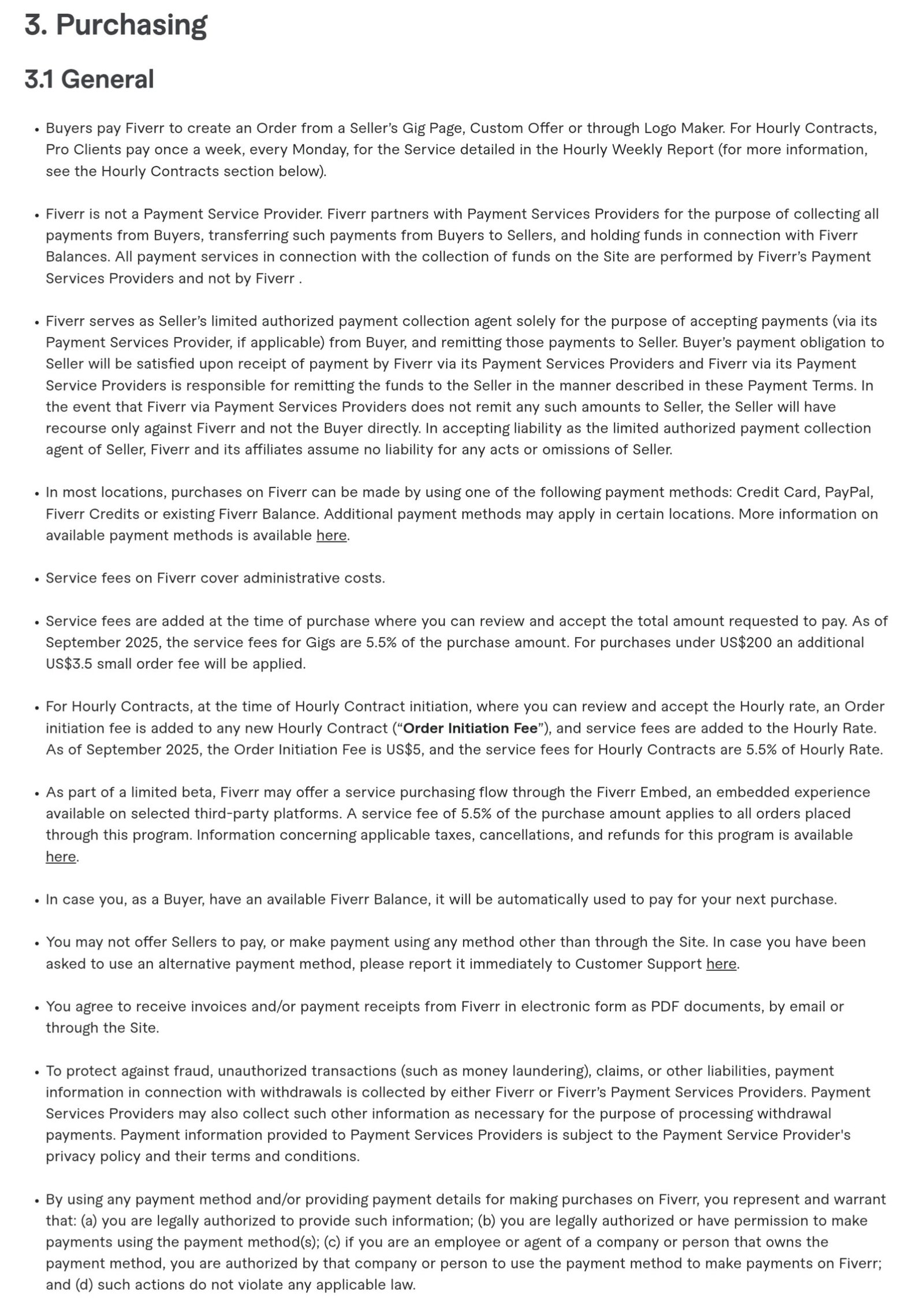
Fiverr takes a flat 20% from every seller payment. No exceptions, no discount for long-term relationships, no loyalty tier. On a $100 order, you keep $80. On a $500 order, you keep $400. That 20% is fixed whether it’s your first order or your thousandth.
Buyers also pay a service fee: $2.49 on purchases up to $50, $3.99 for purchases $50.01–$100, and 5% on purchases over $100. This buyer fee doesn’t come from your earnings, but it does inflate what buyers see at checkout — which can affect conversion, especially on lower-priced Gigs where the flat fees are proportionally higher.
Upwork Fees
Upwork charges a variable freelancer service fee of 0–15% per contract, set when you submit a proposal and visible before you apply. Most freelancers pay around 10% on the majority of their contracts. The rate is determined by Upwork based on factors like skill demand and market conditions — it’s locked in once a contract starts and won’t change mid-contract. Clients pay a separate marketplace fee of up to 7.99% on their end.
Beyond the service fee, Connects cost $0.15 each for proposals. That’s it. No hidden charges, no per-project fees on top.
💰 Real Fee Comparison on $500 Earned
On $500 in gross earnings, Upwork puts roughly $35 more in your pocket than Fiverr, even after Connects costs. Scale that to $5,000 per month and the gap grows to around $350 in Upwork’s favour every single month — that’s over $4,000 a year in fees you’re not paying.
Which Platform Gets You Hired Faster?
For someone starting with zero reviews, Fiverr wins this round — and it’s not particularly close. You publish a Gig and buyers can discover and order from you the same day. There’s no proposal to write, no Connects to spend, and no rejection email to deal with.
The catch, and it’s a real one: Fiverr’s algorithm strongly favours sellers who already have reviews. A brand-new Gig with zero stars sits below hundreds of competitors with 4.9-star ratings and thousands of completed orders. Most new sellers need to price aggressively at first and promote their Gig externally — LinkedIn, social media, relevant communities — just to get those first two or three reviews.
A content writer who started on Fiverr described the first month honestly: “I priced my blog post Gig at $15 for 500 words — embarrassingly low — just to get my first five reviews. The moment I had those five reviews and bumped the price to $45, orders started coming in without me doing anything. The platform only starts working for you once you have proof you exist.”
Upwork’s First Job Timeline
For new Upwork freelancers sending 10 to 15 proposals per week, the typical window for a first contract is 4 to 12 weeks. That timeline depends heavily on your niche — narrow specialisations with less competition convert faster — and how strong your proposal and profile are.
The first Upwork review is the critical milestone. Before it, your profile reads as unproven regardless of how good your portfolio looks. After it, win rates on proposals jump noticeably.
Technical services (development, data, consulting): Start on Upwork. Clients who need complex work post detailed job descriptions and want to evaluate you first — that process suits Upwork’s proposal model far better than a Gig shelf.
Client Quality
This is where the two platforms feel most different day-to-day — not in the features, but in who’s actually on the other end of the conversation.
Fiverr buyers on the standard marketplace are typically budget-conscious. They’re looking for fast, affordable deliverables — a $30 logo, a quick 500-word article, a 60-second voiceover. According to Fiverr’s 2024 annual report, the average buyer spent $284 per year on the platform — a figure that reflects a high-volume, lower-ticket customer base. A logo designer who’s been on Fiverr for three years told us: “The buyers are fine, but I do get the occasional person who expects five revision rounds on a $25 order and leaves a 3-star review because I didn’t read their mind. You learn to spot them in the first message.”
Fiverr Pro changes this significantly. The Pro tier connects vetted premium sellers to business buyers who expect higher quality and pay accordingly. Reaching Pro requires a formal application and a demonstrated track record — it’s not something you apply for on day one.
Upwork attracts a much wider client range, including a meaningful number at the enterprise level. Third-party analyses of publicly available data estimate that many Upwork clients spend over $5,000 per year on the platform, with large accounts spending six figures. These clients post detailed briefs, ask real questions before hiring, and generally treat the relationship more like hiring a contractor than buying something off a shelf.
Earning Potential
Upwork pays more on average, and the numbers bear that out fairly clearly. According to analyses of Upwork’s historical data by third-party researchers, the average project value is estimated at around $800, with a meaningful percentage of contracts paying $1,000 or more. Upwork no longer publishes precise project averages in its reports, but its mix of larger, long-term contracts clearly supports higher per-project earnings than Fiverr’s marketplace.
Fiverr’s average order ranges from $50 to $500. Income on Fiverr scales through volume and repeat buyers, not through high per-project rates. The average Fiverr seller earns somewhere between $5,000 and $30,000 per year, though top performers — Pro sellers in particular — can earn significantly more. Some Pro sellers have publicly reported earnings well into six figures, though these are outliers who’ve built a substantial review base and niche reputation over years.
For freelancers in specialised fields — software development, data science, financial consulting — Upwork’s higher project values combined with its lower service fee (typically around 10%) produce meaningfully better take-home pay. For creative service providers running a high-volume Gig business who’ve built their review base, Fiverr can be genuinely competitive on income — just through a different route.
Best Niches Per Platform
Both platforms cover a huge range of services, but they don’t perform equally across all of them. Through conversations with freelancers across different fields, a consistent pattern emerges.
Fiverr Works Better For
- Logo and brand identity design
- Social media graphics and content
- Video editing and short-form video
- Voiceover recording
- Article writing and blog posts
- Translation services
- Quick website builds and vibe coding
- Interior design renders and 3D visuals
Upwork Works Better For
- Full-stack and mobile software development
- AI and machine learning engineering
- UX/UI design (ongoing product work)
- Technical writing and documentation
- Digital marketing strategy and management
- Financial analysis and accounting
- Legal consulting
- Data science and business analytics
AI Tools Available in 2025/2026
Both platforms have rolled out AI features over the past year, and they work very differently depending on whether you’re a buyer or a seller.
Upwork’s Uma: Uma is Upwork’s built-in AI assistant. For freelancers, it helps with writing proposals — it can review a job post and help you draft a more targeted cover letter faster. It’s baked into the proposal flow rather than being a separate tool you have to go looking for. Freelancers who’ve used it consistently say it’s genuinely useful for the first draft of a proposal, though the final version still needs your own voice to stand out.
Fiverr Neo and Fiverr Go: Neo is a buyer-facing AI assistant that takes a project brief and recommends relevant Gigs automatically — which means it can push your Gig in front of buyers who might not have found it through regular search. Fiverr Go is seller-facing and arguably more interesting: it lets sellers train a personalised AI assistant based on their own style, past work, and communication tone, which can then respond to buyer enquiries on their behalf between working hours. Since Fiverr’s algorithm penalises slow response times, Fiverr Go solves a real practical problem for sellers who can’t be online constantly.
Dispute Resolution
Nobody wants to think about this section. But if you freelance for long enough, you’ll need it — and the difference between these two platforms is significant enough to affect which one you should use for high-value projects.
Fiverr: Disputes go through the Resolution Centre. Fiverr can issue partial or full refunds to buyers, and the process doesn’t always involve a thorough review of whether the delivered work actually met the agreed scope. A web designer shared a frustrating experience: “I delivered a full five-page WordPress site exactly to the brief. The buyer said they ‘changed their mind’ and opened a dispute. Fiverr refunded them 50% without asking to see the delivered files. That was a $400 project.” For lower-ticket work under $200, the risk is manageable. For anything significant, it’s a genuine concern worth factoring into your decision.
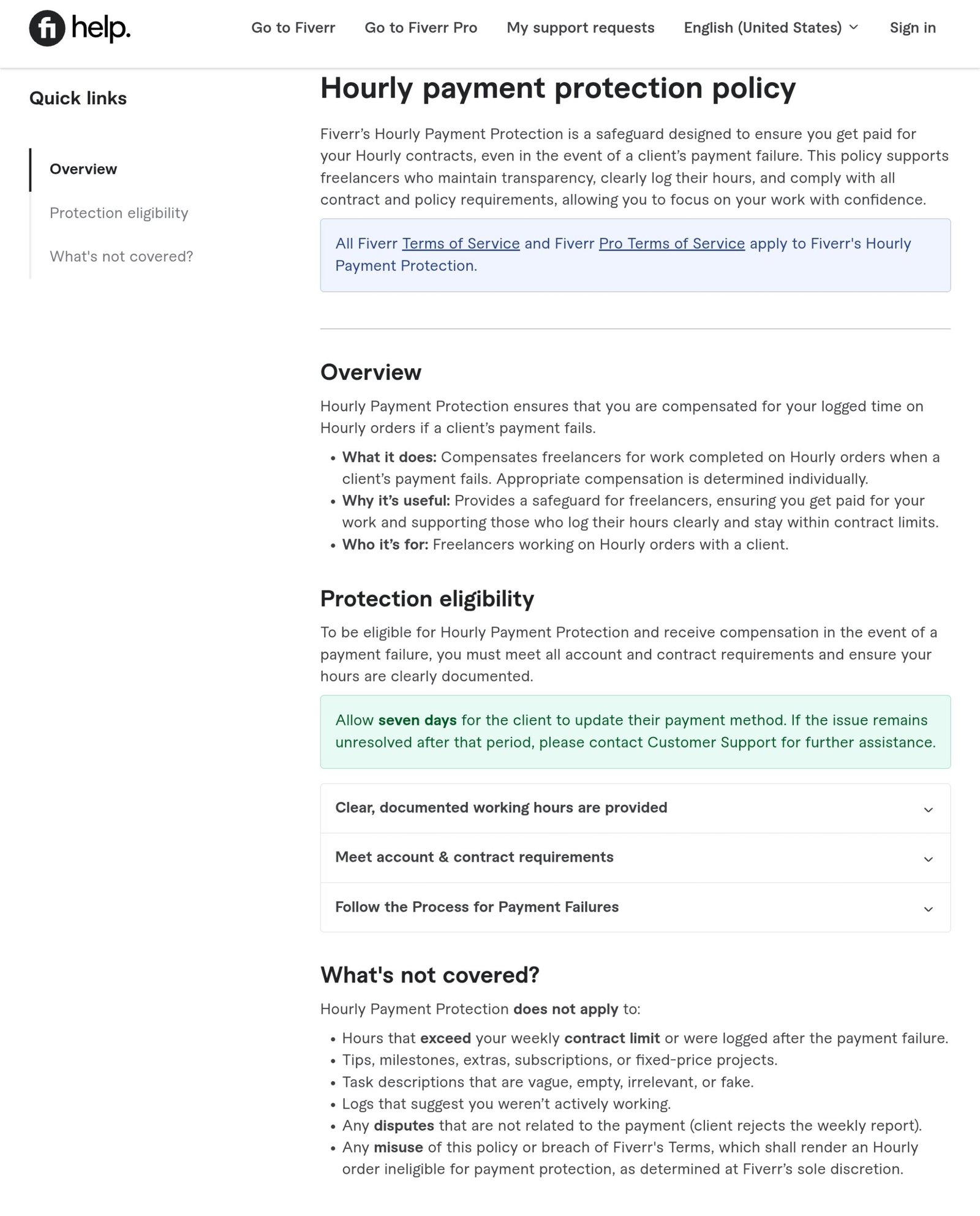
Upwork: Upwork’s dispute process is more structured and, frankly, more protective of freelancers. For hourly contracts, funds are released weekly based on tracked work activity — screenshots and time logs that serve as objective evidence. For fixed-price contracts, milestones hold funds in escrow until both parties confirm completion, and disputes go through a formal review process before any refund is issued. It’s not perfect, but it’s a meaningfully more balanced system when the numbers involved are large.
Above $500 per project: Upwork’s structured escrow and formal review process is worth the extra effort of writing proposals.
Can You Use Both Fiverr and Upwork at the Same Time?
Yes — and a lot of experienced freelancers do exactly this. Neither platform has exclusivity requirements, and running both simultaneously is completely allowed.
The typical approach among established freelancers is to use Fiverr for quick fixed-price orders that come in passively, and Upwork for proposal-based work with long-term clients at higher rates. A graphic designer we spoke to uses both and described it well: “Fiverr pays my fixed costs every month — it’s predictable. Upwork is where I actually build client relationships and the bigger projects come from. Losing either one would hurt, which is exactly why I’m not relying on just one.”
That said, if you’re just starting out, splitting your focus across two platforms usually slows down progress on both. Getting to your first 10 reviews on one platform first — then expanding — is almost always a more effective approach than spreading thin from day one.
Pros and Cons
Fiverr
✓ Fiverr Strengths
- No proposals — buyers come to you
- Faster first order for most service types
- Fixed-price model = predictable income per Gig
- Fiverr Neo AI increases your Gig visibility to buyers
- Fiverr Go lets you automate buyer communication
- 700+ service categories — broad niche coverage
- Fiverr Pro tier gives access to premium buyers
✗ Fiverr Weaknesses
- Flat 20% fee on all earnings — highest of major platforms
- Algorithm strongly favours existing reviews
- Low average order values ($50–$500)
- Dispute resolution can favour buyers on high-ticket work
- Limited support for ongoing hourly relationships
- Entry-level market is very crowded
Upwork
✓ Upwork Strengths
- Lower fees — variable 0–15% per contract (typically ~10%)
- Higher average project values (est. ~$800 in 2026)
- Structured milestone escrow — better freelancer protection
- Long-term contract support (hourly retainers)
- Access to enterprise-level clients
- Uma AI helps write stronger proposals faster
- JSS and Top Rated system rewards quality work with visibility
✗ Upwork Weaknesses
- Connects cost money before you earn anything
- 4–12 week timeline to first job for new freelancers
- Competitive on broad, popular job categories
- Requires more effort per application (proposals, portfolios)
- Identity verification required upfront
- Higher client expectations for communication and process
Final Verdict — Which Platform Wins by Freelancer Type
Choose Fiverr if you are…
Starting out with no reviews. Offering clearly packaged creative services. Want orders to come to you without writing proposals. Prefer fixed-price, fast-turnaround work. Willing to grow through volume and Gig optimisation.
Choose Upwork if you are…
Experienced with a strong portfolio. Offering technical, strategic, or consulting services. Want long-term client relationships and recurring income. Comfortable writing proposals. Prioritise higher per-project earnings and the lower variable fee (typically ~10%).
If you’re a complete beginner, start on Fiverr — the faster feedback loop and zero upfront cost make it the right first step. If you have real skills and a portfolio already, Upwork will almost certainly pay you more over time. The honest verdict: Fiverr wins on accessibility and speed to first order; Upwork wins on earnings, fees, and client quality for anyone beyond the beginner stage. Running both eventually is the move most serious freelancers land on — not because you can’t choose, but because they genuinely serve different parts of the business.
Quick Decision Table by Service Type
| Service Type | Recommended Platform | Reason |
|---|---|---|
| Logo and graphic design | Fiverr | Gig format suits quick fixed-price creative work |
| Full-stack software development | Upwork | Complex scope needs proposal discussion and milestone contracts |
| Article writing and blogging | Fiverr | High Gig volume, fast orders, word-count packages work well |
| AI/ML engineering | Upwork | Growing demand, high project values, suited to proposal-based hiring |
| Video editing | Fiverr | Visual Gig previews convert well; short-form video is popular |
| Digital marketing strategy | Upwork | Strategy work needs scoping calls and long-term relationships |
| Voiceover recording | Fiverr | Audio previews drive Gig discovery; buyers order immediately |
| Financial analysis / consulting | Upwork | High trust required; client wants to evaluate before hiring |
| Translation services | Either | Both platforms have active translation demand; test both |
| UX/UI design (product work) | Upwork | Ongoing product collaboration suits hourly contracts better |
Frequently Asked Questions
Software engineer and active freelancer since 2020. Completed 150+ projects on Fiverr & Upwork combined — and has hired freelancers too, so he knows both sides of the marketplace. This guide is built on direct experience, real freelancer conversations, and the latest platform data. No guesswork, just honest numbers.