Online Course Platform Reviews · Updated 2026
Is Udemy Worth It in 2026? Review After 10 Courses Tested
Udemy’s course catalog is enormous and its sale prices are genuinely low — but the platform’s certificates carry no accreditation, its subscription plan deletes your progress the moment you cancel, and its Trustpilot rating is rough. In this Udemy review, after testing 10 courses across coding, design, data, and business topics, here’s the honest breakdown of what you’re actually getting.
Udemy is one of the best-value learning platforms available, not because every course is excellent, but because sale pricing, lifetime access, and good filtering make quality learning genuinely affordable. The honest catch: the certificate is a PDF that says you finished something, nothing more.
What Is Udemy?
Udemy launched in 2010 on a simple idea: let anyone teach, let anyone learn. That open marketplace model has grown into a catalog of 250,000+ courses covering everything from Python and Premiere Pro to guitar and small business accounting, taught by tens of thousands of independent instructors. Unlike Coursera or edX, no university or company gatekeeps what gets published — any instructor can upload a course and start selling it. That openness is what makes Udemy both exciting and occasionally frustrating to navigate.
As of 2026, Udemy has 84 million registered learners globally. Every course is self-paced with no deadlines. The mobile apps hold up well too — iOS sits around 4.7/5, Android around 4.3/5 from roughly 450,000 ratings.
Udemy Pricing: Every Plan Explained
Almost nobody pays Udemy’s listed price. The platform runs sales constantly, so the discounted rate is effectively the real price. Here’s how the full system breaks down:
| Tier | Price | What you get |
|---|---|---|
| Individual course (listed) | $19.99–$199.99 | Ignore this — see sale price below |
| Individual course (sale) | $9.99–$14.99 | Lifetime access, certificate of completion, 30-day refund window |
| Personal Plan (subscription) | $14–$32/month (varies by region, billing term & promo) | 26,000+ curated courses, 7-day free trial, no refund after trial |
| Team Plan | Custom, annual billing | 26,000+ curated courses, team analytics, admin dashboard, 2–20+ seats |
Does the Udemy Personal Plan Include All Courses?
No. The Personal Plan gives access to a curated set of roughly 26,000 courses out of Udemy’s full 250,000+ course catalog — its highest-rated, most in-demand titles across tech, business, and personal development. Many best-sellers and almost all brand-new course releases are excluded and must be bought individually. Check that your specific target course is actually in the subscription library — via Udemy’s official pricing page — before assuming the subscription covers it.
Course Quality — The Honest Truth
Because anyone can publish a course, quality varies more than most reviews admit. During testing, some courses had crisp production, well-structured modules, and instructors who actually responded in the Q&A. Others felt thrown together over a weekend. Both types can carry decent star ratings if they’ve simply accumulated enough old reviews. A few filters separate the two reliably:
- Filter to 4.5 stars and above — below that is a lottery
- Look for at least 5,000 student reviews, not a high rating from 40 people
- Check the last updated date — anything older than 18 months in a fast-moving technical field is risky
- Preview the free lectures first — production quality is obvious within five minutes
- Check whether the instructor actually responds in the Q&A section
Are Udemy Certificates Worth Anything to Employers?
A Udemy certificate is a PDF confirming you finished a course — no external accreditation body, no institution backing it, no independent verification. Treat it as evidence of effort, not proof of qualification: useful alongside real portfolio work, but not a standalone credential. That’s a fundamentally different situation from Coursera, which issues credentials backed by 350+ university and company partners, including Stanford, Google, and IBM. If the certificate itself is the goal, Udemy is the wrong tool for that job.
Udemy’s Refund Policy — The Full Picture
Udemy’s 30-day refund policy on individual courses sounds clean, but a few caveats matter in practice:
- Refunds can be declined if you’ve already watched a significant chunk of the course
- Multiple refund requests can flag your account and lead to future denials
- Purchases made through Apple or Google Play must be refunded through those stores directly, not Udemy
- Some refunds return as Udemy credit rather than back to your original payment method
- Personal Plan subscriptions carry no refund guarantee at all once purchased — Udemy’s own terms state subscriptions don’t include the 30-day guarantee. The 7-day free trial is your only no-risk window; cancel before it ends if you don’t want to be charged
Is Udemy Legit? What the Reviews Really Say
Yes, Udemy is a legitimate company — it’s been operating since 2010, is now part of a publicly traded, NYSE-listed parent company post-merger, and has processed millions of course transactions. “Legit” and “frictionless,” though, are two different questions. On Trustpilot, Udemy currently sits at roughly 1.8/5 from nearly 1,900 reviews — rated “Bad.” The complaints cluster almost entirely around billing and refund disputes (auto-renewals, declined refunds, slow support), not course content itself.
That’s a useful split to keep in mind: the app store ratings tell a very different story (4.7/5 on iOS, 4.3/5 on Android from roughly 450,000 ratings), and Reddit and Quora threads on Udemy tend to focus on course-quality questions rather than trust concerns. The friction is concentrated in support and billing, not the learning experience itself.
Udemy vs Coursera vs LinkedIn Learning
| Factor | Udemy | Coursera | LinkedIn Learning |
|---|---|---|---|
| Content source | Independent instructors, open marketplace | Universities & companies (Stanford, Google, IBM) | Vetted instructors |
| Price | $9.99–$14.99/course (sale) | $49–$99/course or $399/yr Plus | $239.88/year |
| Number of courses | 250,000+ | 10,000+ | 21,000+ |
| Accredited certificates | ✗ No | Degrees only — most certificates aren’t | Partial |
| University/company partners | None | 350+ | None |
| Access model | Lifetime (individual purchase) | Subscription | Subscription |
| Refund policy | 30 days (individual courses only) | 14 days (annual Plus) | 30 days |
| Best for | Practical, low-cost skills | Career credentials, accredited degrees | Business skills |
So, Udemy vs Coursera — which actually wins? It depends what you’re optimizing for. If you want to learn a specific skill cheaply and keep it forever, Udemy wins outright. If the certificate needs to carry weight on its own, Coursera’s university backing is the deciding factor, not the price difference.
Comparing other platforms too?
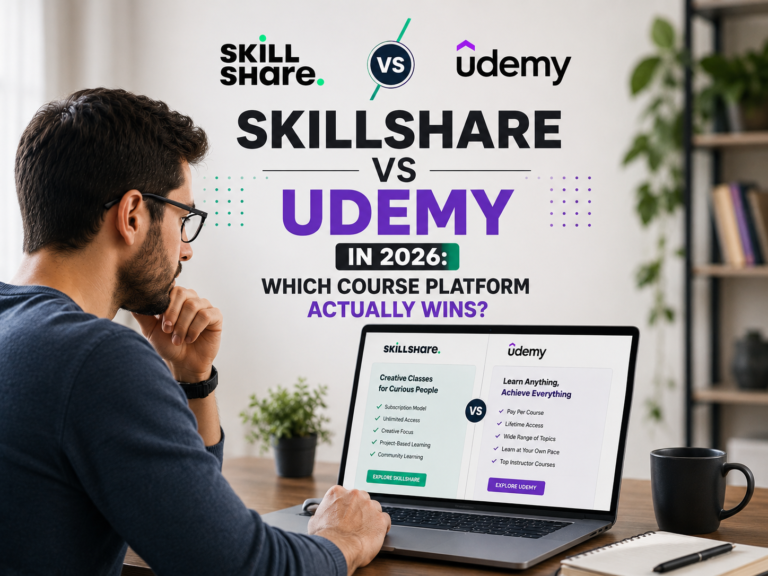
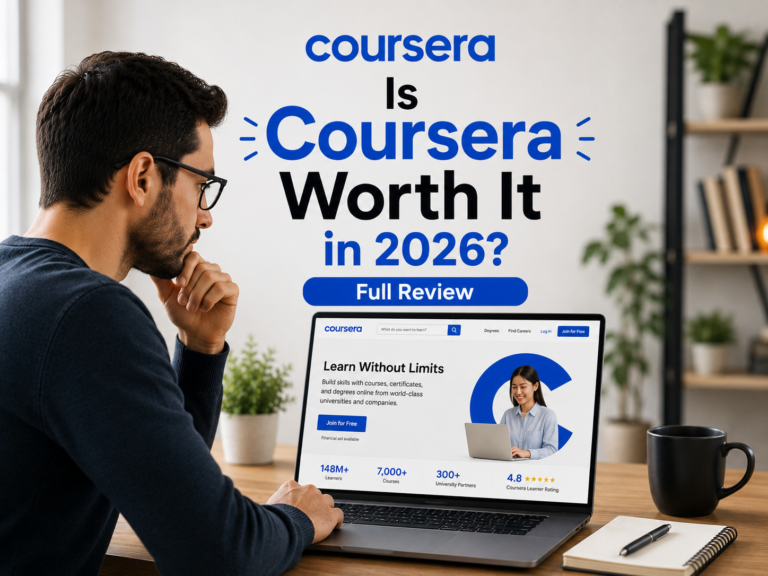
Read our Is Coursera Worth It review and Is LinkedIn Learning Worth It review, or the Skillshare vs Udemy comparison before deciding which platform actually fits your goal.
Pros and Cons
- ✓ Sale prices bring most courses to $9.99–$14.99 — exceptional value
- ✓ Lifetime access on every individually purchased course
- ✓ 250,000+ courses covering virtually every topic imaginable
- ✓ Fully self-paced, no deadlines or cohorts
- ✓ 30-day money-back guarantee on individual courses
- ✓ 600+ genuinely free courses with no payment required
- ✕ Certificates carry no accreditation — completion-only PDFs
- ✕ Open marketplace means quality varies significantly between courses
- ✕ Personal Plan: certificates and progress disappear immediately on cancellation
- ✕ No refund guarantee on the Personal Plan beyond the 7-day trial
- ✕ Trustpilot rating around 1.8/5 — billing and refund complaints are frequent
Final Verdict: Is Udemy Worth It?
Pay for it if: you want a practical skill quickly and cheaply, you’re self-motivated enough to learn without external deadlines, and you’re building portfolio skills rather than chasing a formal credential.
Skip it if: you need an accredited certificate that stands alone in a job application — Coursera’s university partnerships make a real difference there, and the price gap is worth it if you specifically need that recognition.
Best approach: wait for a sale before buying anything, filter to 4.5+ stars with 5,000+ reviews, and use the Personal Plan’s 7-day trial fully before committing, since cancelling wipes your progress immediately.
Frequently Asked Questions
Is Udemy worth it for complete beginners?
Yes — it’s one of the better starting points for beginners. The self-paced format removes the pressure of keeping up with a live class, and at $9.99–$14.99 you can pick up two or three courses for less than a textbook. Stick to 4.5+ stars, 5,000+ reviews, and a recent update date, and the odds of a genuinely useful course are quite high.
Is Udemy legit?
Yes. Udemy is a legitimate, well-established company that’s been operating since 2010 and is now part of NYSE-listed Coursera following their May 2026 merger. Its Trustpilot score is weak (roughly 1.8/5), but the complaints driving that score are almost entirely about billing and refunds rather than course quality or fraud — the app store ratings (4.7/5 iOS, 4.3/5 Android) reflect the actual learning experience more accurately.
Does the Udemy Personal Plan include all courses?
No. The Personal Plan covers roughly 26,000 curated, top-rated courses out of Udemy’s 250,000+ total catalog. Best-sellers and many newly published courses are frequently excluded and have to be purchased individually — always check a specific course’s inclusion before subscribing.
Are Udemy certificates recognised by employers?
No, not as a standalone qualification. A Udemy certificate confirms you completed a course — nothing more. It can support a portfolio, but it won’t open doors by itself. If you need a credential that stands alone, Coursera’s university-backed certificates are in a different category.
Does Udemy have a free trial?
The Personal Plan includes a 7-day free trial. Individual courses don’t have a trial, but there are 600+ genuinely free courses, and every paid course lets you preview several lectures before buying.
What is Udemy’s refund policy?
Individual courses come with a 30-day money-back guarantee, though Udemy can decline it if you’ve watched most of the content, and repeated refund requests can flag your account. Purchases through Apple or Google Play follow those stores’ own refund rules. The Personal Plan has no refund guarantee once purchased — only the 7-day trial is risk-free.
Is the Udemy Personal Plan worth it?
If you’re completing two or more courses a month from its 26,000+ course library, the math works out. If you dip in occasionally, buying individual courses on sale is usually cheaper — and remember cancelling removes your certificates and progress immediately.
Is Udemy better than Coursera?
They’re better at different things. Udemy wins on price, catalog size, and lifetime access for practical skills. Coursera wins on credential value — a certificate with Stanford’s or Google’s name on it carries real weight in a job application. Note that Coursera and Udemy are now sister companies under one parent (merger completed May 11, 2026), though they still operate as separate platforms.