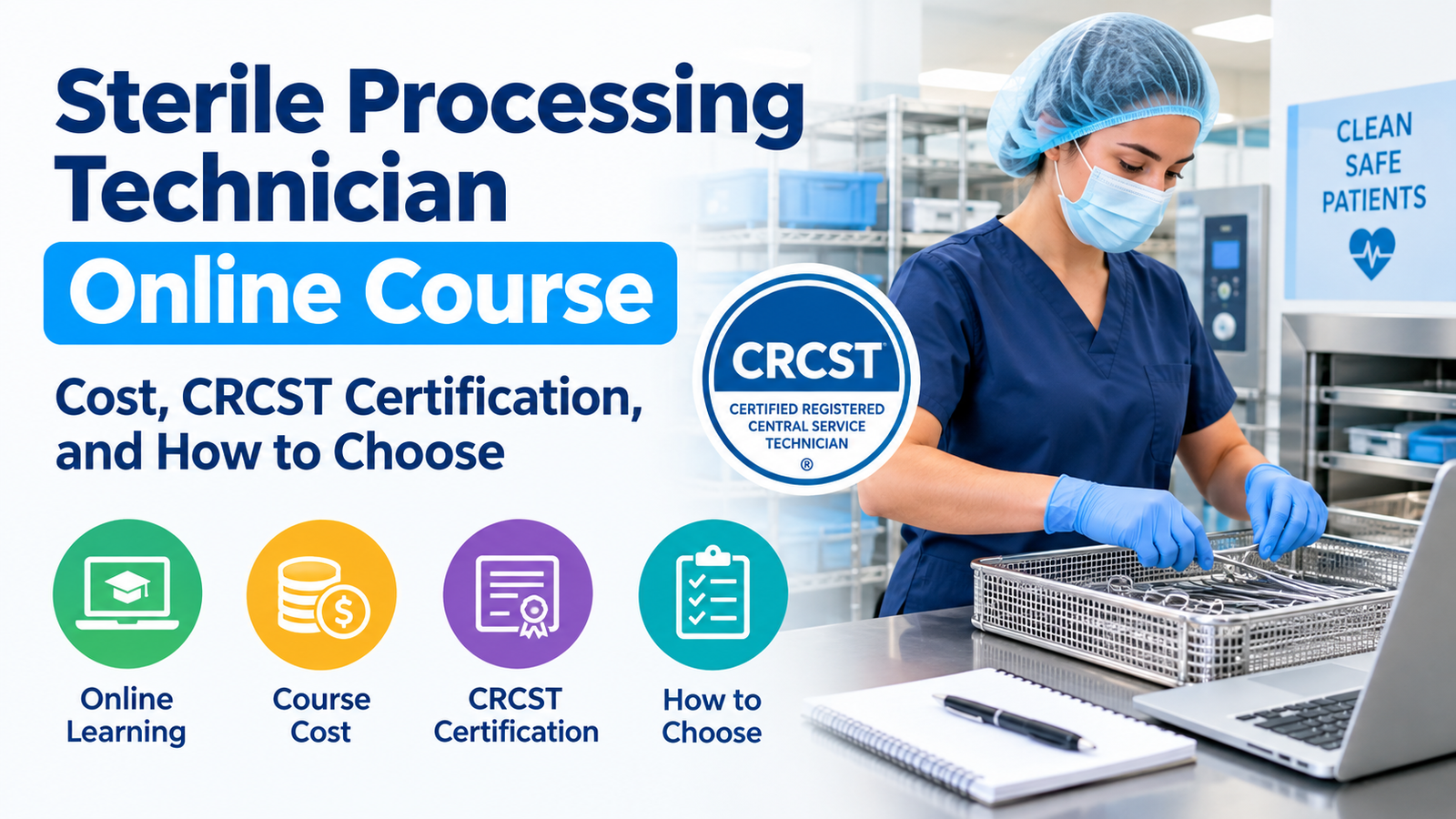
Sterile Processing Technician Online Course: Cost, CRCST Certification, and How to Choose
Finishing a sterile processing technician online course does not make you certified. It prepares you for an exam. For the CRCST credential from HSPA, certification also requires 400 hours of hands-on experience in a sterile processing department, and HSPA says it is your responsibility to find a department for those hours. The CSPDT credential from CBSPD lists a different route, covered below.
Search for a sterile processing technician online course and you will find prices from under $1,000 to about $3,000 and up. This guide covers what a sterile processing technician does, how CRCST and CSPDT certification differ, which states require certification, four online options with prices and terms taken from their own pages, and the part that catches most people out: how to get your hands-on hours. HSPA, CBSPD, BLS and each program’s page were checked in late September 2026, and prices and offers can change.
Self-paced online diplomas from schools such as Penn Foster ($949 to $1,249) and US Career Institute ($979 to $1,279) cover the exam content for a fraction of the cost of higher-priced courses, and both help with the CRCST exam fee. HSPA says a course is not required at all to sit the exam, so what really separates people’s paths is not the course price. It is how quickly they can line up either the 400 hands-on hours for CRCST or qualifying experience or training for CSPDT.
On this page
- What does a sterile processing technician do?
- Sterile processing technician certification: CRCST vs CSPDT
- Does your state require certification?
- Sterile processing technician training: what courses cover and what they do not
- How long does it take?
- Sterile processing technician online courses compared
- What sterile processing technicians earn
- Who this career fits
- How to choose a program
- Mistakes to avoid
- FAQ
What Does a Sterile Processing Technician Do?
A sterile processing technician, also called a central service technician, SPD tech or sterile processing tech, cleans, inspects, assembles and sterilizes reusable surgical instruments and medical devices. HSPA describes the CRCST role as decontaminating, inspecting, assembling, disassembling, packaging and sterilizing reusable surgical instruments or devices in a healthcare facility. The work happens in the sterile processing department rather than at the bedside, but it sits upstream of patient safety, because instruments must be reprocessed correctly before the next procedure.
Typical tasks include decontaminating used instruments, inspecting them for damage or residue, assembling trays to a specification, running and monitoring sterilizers, and documenting each load. BLS lists a high school diploma or equivalent as the typical entry-level education, with moderate-term on-the-job training.
Sterile Processing Technician Certification: CRCST vs CSPDT
Two organizations certify sterile processing technicians in the US, and most courses prepare you for one of their two entry-level exams. Here is how they compare, based on each organization’s own page.
| Factor | CRCST (HSPA) | CSPDT (CBSPD) |
|---|---|---|
| Full name | Certified Registered Central Service Technician | Certified Sterile Processing and Distribution Technician |
| Eligibility | 400 hours of hands-on experience in a sterile processing department, paid or volunteer. Full certification needs the hours in the previous five years. Provisional certification lets you test first and submit the hours within six months of passing | Meet one of four routes: 12 months of full-time SPD work; 6 months in SPD plus 6 months in a related allied health role; completion of a sterile processing technician training course with a grade of 70 or higher; or 12 months of healthcare product sales or service related to SPD |
| Exam | 150 multiple-choice questions, three hours, computer-based at a Prometric testing facility. Application fee $140 for one attempt | 150 questions (125 scored plus 25 unscored pretest), three hours, passing scaled score of 70. Exam fee $135, and convenience fees may apply |
| Application | Online or by paper | CBSPD says the application cannot be completed online and must be printed and mailed. Exams are offered in one-week windows in February, May, August and November |
| Length and renewal | Renewed with continuing education and a fee | Certification length of five years |
| Accreditation | HSPA says CRCST is accredited by ANAB and NCCA | Check CBSPD’s site for its current accreditation statement |
The most useful difference for course shoppers is the CSPDT eligibility list. CBSPD includes completing a sterile processing technician training course with a passing grade as one qualifying route, so an online course can lead more directly to the CSPDT exam than to full CRCST certification. Confirm with CBSPD that your specific course qualifies before you enroll. Many online courses are built around CRCST because HSPA’s credential is the one many job postings name, so if a specific employer prefers one credential, check that first.
Does Your State Require Certification?
No US state requires a government-issued license to work as a sterile processing technician, but several have made certification a legal requirement for employment. HSPA’s advocacy page lists Connecticut, New Jersey, New York, Pennsylvania and Tennessee as requiring certification, and some training providers and schools also list Delaware. State laws differ on how long you have after being hired to certify, who is covered, and which credentials count, and new laws are being introduced, so check your state’s current rule with HSPA’s advocacy page or the state health department.
Outside those states, certification is usually set by the employer. Many hospitals prefer or require it, and some hire uncertified applicants on the condition that they certify within a set time. Check real job postings in your area to see what local employers ask for.
Sterile Processing Technician Training: What Courses Cover and What They Do Not
Penn Foster and US Career Institute describe covering infection prevention, aseptic technique, instrument decontamination and sterilization, inventory management, quality assurance and related regulations, which map to the content areas HSPA lists for the CRCST exam: departmental considerations, cleaning, decontamination and disinfection, preparation and packaging, the sterilization process, sterile storage and inventory management, patient care equipment, and professional skills.
None of the online diplomas compared below place you in a hospital. Penn Foster says it does not require students to complete the CRCST exam or the 400 hours, and US Career Institute says it will not provide that training. HSPA says it also does not provide placement services. If you want full CRCST certification, plan how you will get the hours: HSPA lists them as 120 hours of decontamination, 120 of preparing and packaging, 120 of sterilization and disinfection, 24 of storage and distribution, and 16 of quality assurance, which must be documented by a supervisor or manager who physically witnessed you doing the work.
Practically, most people complete the coursework, apply for entry-level or trainee sterile processing openings, and log hours while working, or arrange volunteer hours. HSPA accepts paid or volunteer hours, and you do not need to be currently employed to test, but the sign-off must come from a department that is authorized to document your hours.
How Long Does It Take?
- Penn Foster: as fast as about 2 months, with an average of about 4 months, since the program is self-paced.
- US Career Institute: as little as 4 months, with many students finishing in about 9 months.
- C-TEC: 12 months of access to a course listed at 190 course hours.
These times cover coursework only. HSPA says 400 hours represents a minimum of about 10 weeks of experience, so for CRCST add the time it takes you to find and complete those hours. For most people the realistic total is six months to a year, depending on how fast you can start working or volunteering in a department.
Sterile Processing Technician Online Courses Compared
These four options show the range in price and format. Details come from each provider’s own pages and can change.
| Program | Cost | Duration | Exam fee | Hands-on hours | Notes |
|---|---|---|---|---|---|
| Penn Foster | $949 paid in full (regular price $1,249), or $1,149 on a $59 monthly plan, under a promotion shown through 14 October 2026 | About 2 to 4 months, self-paced | CRCST exam voucher covered in tuition | Not included | Low-cost option. Footer lists DEAC accreditation |
| US Career Institute | $979 paid in full or $1,279 total at $69 a month | As little as 4 months, often about 9 | Reimburses $140 toward the CRCST exam | Not included, student arranges | Longer runway while working. States it is DEAC accredited |
| C-TEC Career Training | $2,995 (listed at $3,290) | 12 months of access, 190 course hours | CRCST exam voucher included | Offers a clinical experience guide and team assistance, not a guaranteed placement | Higher-priced option with help finding hours |
| Purdue University course (listed by HSPA) | See Purdue’s site | Online or by mail | Not included | Not included | The course HSPA itself lists, which it says is not an HSPA product |
Check the price and offer on the provider’s own checkout before you pay. Costs vary because of promotions, payment plans and whether an exam voucher is included, so compare the total including the exam fee and any study materials.
What Sterile Processing Technicians Earn
The U.S. Bureau of Labor Statistics tracks this role as “Medical equipment preparers” (SOC 31-9093). BLS reports 79,900 jobs in 2025 and a May 2025 median annual wage of $47,700, about $22.93 an hour. It projects growth of 11% from 2025 to 2035, adding about 8,700 jobs. BLS lists a high school diploma or equivalent as the typical entry-level education.
That category covers several kinds of equipment preparers, not only hospital sterile processing, and national medians are only a starting point. Check current openings near you on a job board such as Indeed to see local pay and whether employers ask for certification.
Who This Career Fits
Sterile processing suits people who are comfortable with precise, procedure-driven work, such as assembling instrument trays to a specification and following documentation steps every time. It fits those who want a healthcare job without direct patient care. Hospitals run sterile processing around the clock, so shift work, including evenings, weekends and holidays, is common in entry-level roles. If detailed work, little patient contact and rotating shifts sound manageable, the career is a reasonable match before you compare courses.
How to Choose a Program
- You already work in healthcare or an SPD: check CBSPD’s four eligibility routes and HSPA’s experience rules first. You may be able to sit an exam without a paid course, since HSPA says a preparatory course is not required.
- Tight budget and comfortable studying alone: Penn Foster and US Career Institute are the lowest-priced options here and both help with the CRCST exam fee.
- Working full time and need more time: US Career Institute’s longer typical window may suit you better.
- You want help finding hands-on hours: look for programs that include a clinical experience guide or externship, such as C-TEC’s guidance, and ask in writing what is and is not guaranteed.
- You want the CSPDT credential: confirm with CBSPD that your chosen course meets its training course route before you pay.
Mistakes to Avoid
- Assuming a course makes you certified. It prepares you for the exam, and CRCST also needs 400 documented hours.
- Paying much more for a course without checking what it adds, such as a voucher, hours support or longer access, compared with lower-priced options.
- Choosing a course built around one exam before checking which credential your target employer and state expect.
- Waiting until the course ends to look for hands-on hours. Start looking for entry-level openings or volunteer departments while you study.
- Letting someone who did not directly supervise your work sign off your hours. HSPA requires a qualifying supervisor who physically witnessed the work.
- Treating national wage data as a guarantee of local pay.
Frequently Asked Questions
What is sterile processing?
Sterile processing is the hospital process of cleaning, decontaminating, inspecting, assembling and sterilizing reusable medical instruments and devices between uses. It is carried out by sterile processing technicians working in a sterile processing or central service department.
What does a sterile processing technician do?
They decontaminate, inspect, assemble, package and sterilize reusable surgical instruments and devices, run sterilizers, and keep records so instruments are safe for the next patient.
What is CRCST certification?
CRCST is the Certified Registered Central Service Technician credential from HSPA. It requires passing a 150-question exam and completing 400 hours of hands-on experience in a sterile processing department, either before testing or within six months of passing for provisional certification.
Is a sterilization technician the same as a sterile processing technician?
Yes. Sterile processing technician, central service technician, SPD tech and sterilization technician are used interchangeably in job postings, though exact duties vary by employer.
How do I become a sterile processing technician?
Most people complete a training course or learn on the job, gain hands-on experience in a sterile processing department, and pass the CRCST or CSPDT exam. BLS lists a high school diploma or equivalent as the typical entry-level education.
Do I need 400 hands-on hours?
For the CRCST, yes. HSPA requires 400 hours of experience, either before testing or within six months of passing. The CSPDT uses different eligibility routes, including 12 months of SPD work or completion of a training course with a passing grade, so check CBSPD’s requirements.
Can I take the CSPDT exam after an online course?
CBSPD lists completion of a sterile processing technician training course with a grade of 70 or higher as one eligibility route, and you submit proof such as a certificate or grade. Confirm with CBSPD that your specific course qualifies before enrolling.
Is CRCST or CSPDT better?
Many employers accept either, and the better choice depends on your situation. CRCST needs 400 documented hours, while CSPDT has several eligibility routes and a five-year certification length. Check your target employer’s and state’s preference first.
Does my state require certification?
HSPA lists Connecticut, New Jersey, New York, Pennsylvania and Tennessee as requiring certification, and some sources also list Delaware. Rules on timing differ and change, so check your state’s current requirement before choosing a course.
Final Verdict
The course is the cheapest and easiest part of this path, and paying more does not by itself make you certified. The part that takes planning is the experience requirement. Before you enroll, decide whether you are aiming for CRCST, which needs 400 documented hours, or CSPDT, which has a training course route, and work out how you will get the experience or training that qualifies. Do that early, and the rest of becoming a sterile processing technician is a straightforward way into healthcare.
This guide is independently written and not sponsored by any school or certifying body named above. It is for general information only. Confirm current requirements with HSPA, CBSPD, your state and the program you are considering. Sources: HSPA CRCST page, CBSPD technician exam page, BLS and the program pages linked above. Costs and details were checked in late September 2026 and can change.