
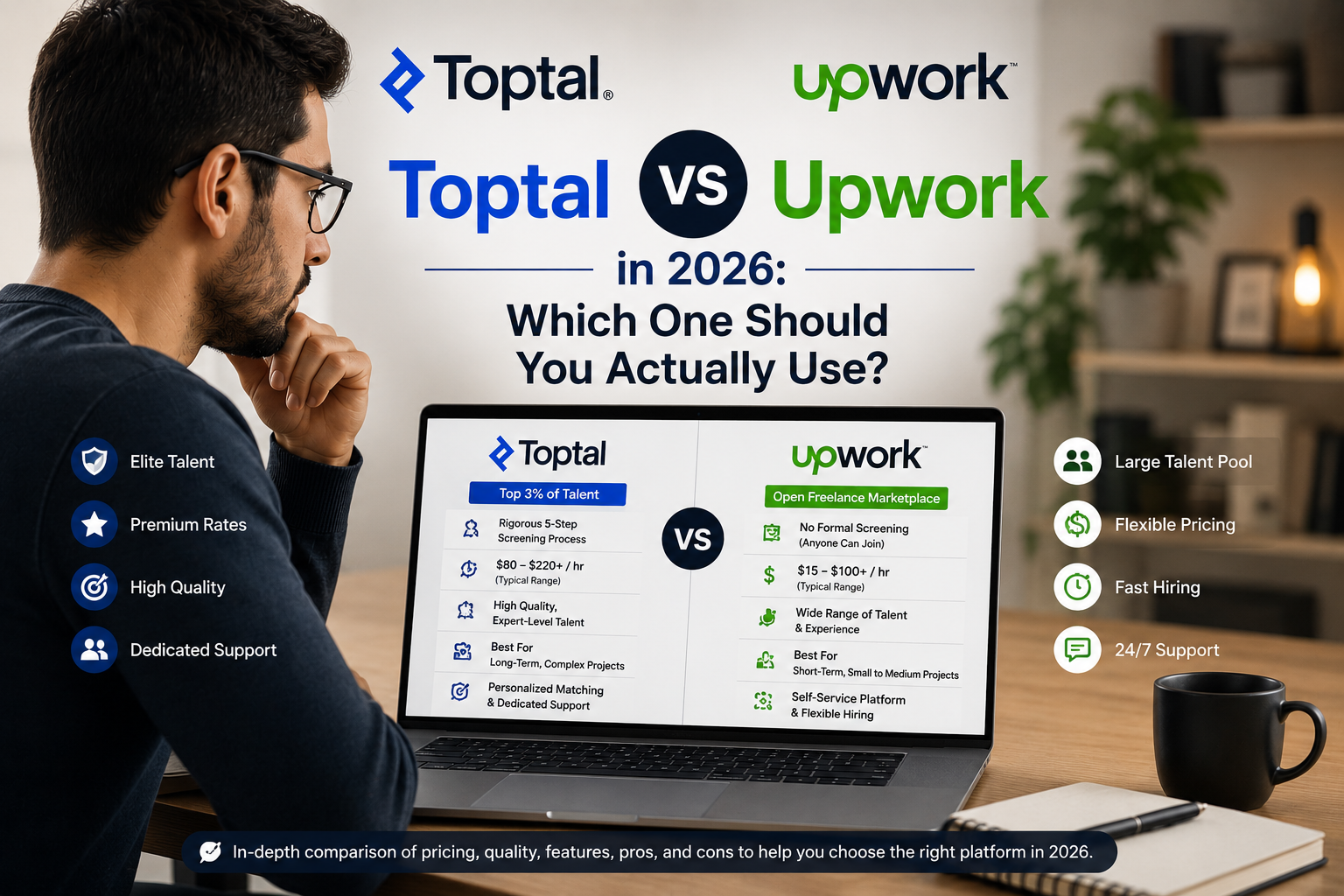
Toptal vs Upwork 2026: Which Platform Actually Pays More?
Toptal vs Upwork at a Glance
Toptal and Upwork solve the same problem — connecting freelancers with clients — from almost opposite directions. One is a strict, invitation-only network; the other is an open marketplace anyone can join within minutes.
| Factor | Toptal | Upwork |
|---|---|---|
| Model | Curated network — must pass screening | Open marketplace — anyone can join |
| Acceptance rate | Under 3% of applicants | No acceptance barrier |
| Time to first job | 2–8 weeks (screening first) | Can start bidding same day |
| Categories | Dev, design, finance, PM only | Nearly every freelance category |
| Freelancer fee | 0% — you keep your full rate | 0–15% variable per contract |
| Client starting cost | ~$500 refundable deposit + ~$79/mo | Free Basic plan available |
| Typical hourly rate | $60–$200+/hr | $15–$200+/hr |
| How you get work | Matched directly by Toptal’s team | You submit proposals and bid |
On This Page
What Is Toptal? What Is Upwork?
Toptal is a talent network for developers, designers, finance experts, and product/project managers — not a job board. You apply to join the network itself, and only freelancers who pass a five-stage screening process get access to client matching. Once accepted, Toptal’s team sends you direct invitations that fit your skills.
Upwork is a general freelance marketplace covering nearly every remote-work category. Anyone can sign up and start submitting proposals within minutes using “Connects,” Upwork’s proposal credits. There’s no quality gate on entry — the market sorts strong freelancers from weak ones over time through reviews.
Want the full screening breakdown? See our Is Toptal Worth It review.
How Does Toptal Work vs Upwork?
On Upwork, clients post a job, you spend Connects to submit a proposal, and the client picks one applicant from a public pool — sometimes dozens deep. It’s a bidding process from start to finish.
Toptal flips that entirely. Once accepted, you stop applying to anything — a Toptal matcher reviews client requirements internally and invites a handful of fitting freelancers directly. Getting in means clearing five stages: a language and communication screening, a skills test, a live interview with a senior expert, an unpaid test project, and a final review call. Toptal estimates the full process takes 3–8 weeks, and roughly 97% of applicants don’t make it through.
Fees Compared: Toptal vs Upwork
Freelancer-Side Fees
Toptal charges freelancers nothing — you keep every dollar you quote. Upwork’s Freelancer Service Fee is variable, 0–15% per contract, shown before you accept and locked in for the contract’s duration. Most freelancers land around 10%. Connects cost $0.15 each, whether or not you land the job.
- Toptal commission (0%)–$0
- Upwork service fee (~10% typical)–$500
- Upwork Connects (active month, est.)–$15
- Toptal net from $5,000 gross$5,000
- Upwork net from $5,000 gross$4,485
Client-Side Fees
Upwork’s Basic plan charges clients 3–5% on payments to freelancers, plus a small contract initiation fee; Business Plus runs 8–10% with added hiring features. Toptal charges a flat structure: a refundable ~$500 deposit, then ~$79/month, with its margin built into the $60–$200+/hour rate you’re quoted.
Bottom line: Upwork is cheaper and more transparent overall for freelancers, but Toptal’s 0% commission wins outright for anyone who gets accepted. For clients, Toptal costs more upfront but removes the screening work.
Vetting & Screening: Is Toptal Legit?
Yes — Toptal’s selectivity is real, not marketing. Upwork has effectively no vetting: a profile goes live immediately, which is fast but means clients can’t tell a strong freelancer from a weak one without reading reviews themselves.
Toptal’s five-stage process — language screening, skills test, live expert interview, unpaid test project, and final review call — typically takes 3–8 weeks, and fewer than 3% of applicants are accepted. That rejection rate is exactly why clients are willing to pay a premium: they’re not vetting you, Toptal already did.
Pay & Earnings: How Much Do Developers Make on Toptal?
Because Upwork has no floor on who can join, its rate range is enormous — roughly $15/hour on entry-level gigs to $200+/hour for specialists with a strong review history. New freelancers typically start lower and build up over months.
Toptal skips that build-up phase. Since every freelancer already passed a strict bar, developers commonly bill $80–$200+/hour depending on specialization and seniority, with designers, finance, and PM specialists in similar or slightly lower bands. The trade-off is volume, not rate: Toptal freelancers run fewer, larger engagements rather than lots of small gigs.
Speed to Get Started
Upwork wins decisively — create a profile and start submitting proposals the same day. Toptal requires clearing the entire screening process first, realistically two to eight weeks with zero income during that stretch. If you need money this month, Upwork (or Fiverr) is the more realistic starting point.
Toptal vs Upwork vs Fiverr (and Other Alternatives)
A few other vetted networks come up when people search “Toptal alternatives”:
- Arc.dev — developer-focused vetted marketplace, generally faster screening than Toptal.
- Upstack — another curated, developer-only network, similar vetting rigor but a smaller pool.
- Lemon.io — lighter-weight vetted network, typically matching within 24 hours at somewhat lower rates.
Pros and Cons of Each
✓ Toptal Strengths
- 0% freelancer commission
- Pre-vetted, higher-budget clients
- No bidding once accepted
- Higher starting rates
✗ Toptal Weaknesses
- 2–8 week unpaid screening, under 3% acceptance
- Only 4 skill categories
- No income during screening
✓ Upwork Strengths
- Start bidding the same day
- Every freelance category
- Wide rate range fits all levels
✗ Upwork Weaknesses
- 0–15% fee plus paid Connects
- Heavy competition, no quality gate
- You screen clients yourself
Final Verdict — Toptal or Upwork?
Choose Toptal if: you’re an experienced developer, designer, finance pro, or PM (2–3+ years) who wants premium clients and 0% commission, and can afford several unpaid weeks of screening.
Choose Upwork if: you’re new to freelancing, work outside Toptal’s four categories, or need to start earning within days.
There’s no single winner — they’re built for different freelancers at different career stages. Plenty of experienced freelancers run both: an active Upwork profile for steady work while going through Toptal’s screening in parallel.
Which Should Clients Choose?
| Client Situation | Platform | Reason |
|---|---|---|
| Need a senior dev fast, quality over price | Toptal | Pre-vetted, matched within days |
| Smaller budget, will screen candidates yourself | Upwork | No deposit or monthly fee |
| Role outside dev/design/finance/PM | Upwork | Toptal doesn’t cover it |
| One-off fixed-price task | Fiverr | Gig pricing suits small deliverables |
| Long-term technical hire, premium budget | Toptal | Fewer, higher-quality candidates |