JobHire.ai Reviews 2026: Pricing, Refund Terms and Complaints Explained
JobHire AI reviews are sharply split: thousands of Trustpilot reviewers praise the automation, while a steady minority describe billing problems, irrelevant applications and refund disputes. This page pulls those signals together with what JobHire.ai itself publishes in its refund policy and FAQ, so you can see the difference between the homepage promise and the fine print before you pay. Sources are linked throughout and were checked in late September 2026.
JobHire.ai is a real, working auto-apply service run by JOBHIRE AI LIMITED, a company with a registered address in Nicosia, Cyprus. It is not a fake storefront, and many users report interviews. The risks are on the commercial side: no free trial, pricing shown only after signup, and a refund policy that says all subscription fees are non-refundable. The “interview in 15 days” idea on the homepage is, in the policy, a possible two weeks of account credit under seven strict conditions, not a cash refund. If you subscribe, pay by credit card, screenshot your plan terms at checkout and set a reminder before renewal.
Table of Contents
- What does JobHire.ai actually do?
- What do JobHire AI reviews on Trustpilot show?
- Is JobHire.ai legit? What we can and cannot confirm about the BBB rating
- What does JobHire.ai cost?
- JobHire.ai refund policy: what it actually says
- Marketing claims vs published facts
- Common complaints in JobHire AI reviews
- When automatic applications can backfire
- Pros and cons
- JobHire.ai alternatives
- How to protect yourself if you sign up
- Who should and should not use it
- FAQ
- Bottom line
What Does JobHire.ai Actually Do?
JobHire.ai is a web-based auto-apply platform for US job searches. You upload a resume, answer questions about the roles and locations you want, and the platform matches jobs, adjusts your resume, writes cover letters and can submit applications for you. According to its own FAQ, you can also review each opportunity yourself instead of letting it apply automatically.
Its refund policy refers to three application modes: Manual-apply, Immediate-apply and Auto-apply. A separate search setting called Fast Track matters for refund eligibility, covered below. The company behind the product is JOBHIRE AI LIMITED, and its footer lists an address in Nicosia, Cyprus.
What Do JobHire AI Reviews on Trustpilot Show?
Trustpilot is the largest public pool of JobHire AI reviews. At the time of checking, the JobHire.ai Trustpilot page showed a TrustScore of 4.1 out of 5 from 1,023 reviews.
| Trustpilot rating | Share of reviews |
|---|---|
| 5 stars | 62% |
| 4 stars | 18% |
| 3 stars | 3% |
| 2 stars | 2% |
| 1 star | 15% |
Two details give context. Trustpilot says the company invites its customers to leave reviews and that it replied to about half of its negative reviews. It also shows that the company holds a paid Trustpilot subscription, which is common and does not by itself change the ratings. The shape of the distribution is the useful part: most reviewers are positive, but a distinct group of roughly one in seven gave one star.
Is JobHire.ai Legit? What We Can and Cannot Confirm About the BBB Rating
JobHire.ai is a functioning product from a registered company, so it is not a scam in the sense of a site that takes money and delivers nothing. Whether it treats customers fairly on billing is a separate question, and that is where the evidence is mixed.
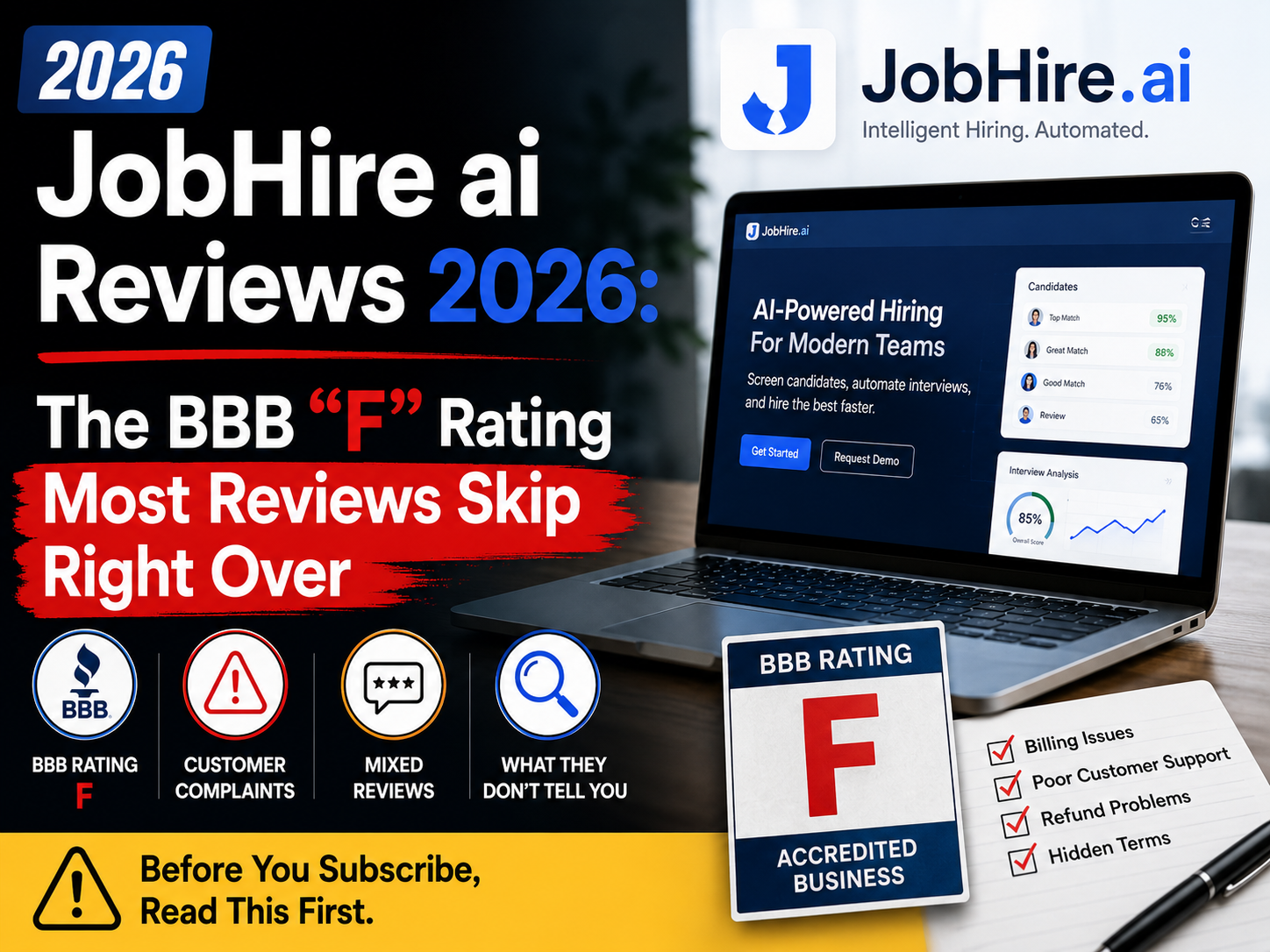
Many JobHire AI reviews on other sites state that the company has an “F” rating from the Better Business Bureau. We could not confirm that. We did not find a BBB business profile showing that grade, one reviewer reports that JobHire.ai disputes the rating and says it has no BBB profile, and another independent review reports that it could not locate a profile carrying an F either. Treat the “F” as a claim repeated across review sites, not a verified fact.
What is publicly visible on BBB is its Scam Tracker, which includes reports that name jobhire.ai. One older report says the service advertised 200 applications a day but delivered about 30 on one platform, and that a promised refund never arrived. A January 2026 report says only one application went out, to an unrelated role. These are anonymous consumer submissions, not findings by BBB and not a rating, so they show the type of complaint people make rather than how common it is.
What Does JobHire.ai Cost?
JobHire.ai does not publish prices on its public pages. Its FAQ says there are three subscription plans and that the pricing section appears after you sign up. It also says there is no free trial, but that people who subscribe right after registering can unlock a one-time discount. Plan names differ between pages and reviewers, with Standard, Pro and Extended on the FAQ and Starter, Pro and Pro+ reported from the homepage.
Third-party reviewers commonly report an entry price of around $49 a month and higher-volume or longer plans up to about $199, but those figures are not published by the company and can change. Confirm the exact price, term, renewal date and application limit on the checkout screen before you pay, and take a screenshot.
JobHire.ai Refund Policy: What It Actually Says
The details below come from JobHire.ai’s own refund policy, which was last updated on July 17, 2026 and states that it supersedes earlier refund terms. If you read an older JobHire AI review that mentions a refund for no interview within 15 days, it is describing earlier or marketing wording, not this policy.
- General rule: all subscription fees, for initial purchases and renewals, are non-refundable.
- Cash refunds: issued only for billing errors, such as duplicate charges, charges after a confirmed cancellation, or an incorrect amount.
- If you get no interviews: you may be eligible for account credit equal to two additional weeks of service, not a refund to your card.
- Renewals: a renewed term is non-refundable once the service has been active. Credit is possible only if you ask within 24 hours of renewal and your search was paused so the service did no work.
- Technical problems: account credit if a verified issue on JobHire.ai’s side stopped the service working, requested within 15 days of the issue.
The seven conditions for the two-week credit
All of the following must be true at the time of your request:
- At least 15 days have passed since purchase, and you ask within 30 days of purchase.
- You have received no interview invitations.
- Your search mode was set to Fast Track.
- All work types (remote, hybrid and on-site) were selected.
- At least five states were selected, including at least one of California, Texas, New York, Florida or Illinois.
- Your application mode was Auto-apply or Immediate-apply, not Manual-apply.
- Your role, seniority, salary and location targets were reasonable and consistent with your resume.
Marketing Claims vs Published Facts
| What the marketing suggests | What the published pages show |
|---|---|
| “Get invited to interview in 15 days” | The refund policy offers two weeks of account credit under seven conditions. It does not promise an interview or a cash refund. |
| “Bypasses ATS filters” | This is marketing language. Software can format a resume so it parses cleanly, but it cannot override an employer’s own screening rules. |
| “15,000 jobseekers found their dream job” | This is the company’s own statement on its FAQ page. It is not independently verified, and the page does not explain how it was counted. |
| Pricing is “clearly laid out” | The FAQ says pricing is shown after you sign up, so you cannot compare plans before creating an account. |
| A glowing Trustpilot widget on the homepage | ApplyAll, a competing service, observed in August 2026 that the widget said it was showing only 4 and 5 star reviews. The full Trustpilot page includes a 15% share of one-star reviews. |
Common Complaints in JobHire AI Reviews
- Billing and cancellation. The most frequent theme in negative JobHire AI reviews is being charged at renewal and struggling to cancel or get money back. This lines up with the policy language: renewals are non-refundable once the service has run.
- Irrelevant matches. Some reviewers report applications going to roles at the wrong level or location. One commonly quoted user said they received calls for junior roles despite having ten years of experience, and that tightening the filters took time.
- Volume lower than advertised. The older BBB Scam Tracker report above describes 30 applications a day against a 200 a day claim. Daily limits depend on the plan, so check yours at checkout.
- Support response. Reviewers and Trustpilot’s own summary mention slow replies or hard-to-find cancellation options.
When Automatic Applications Can Backfire
More applications is not automatically better. Many employers use applicant tracking systems that keep a record of each candidate’s applications to that company, so a recruiter reviewing one application may be able to see others you submitted. A string of unrelated applications to one employer can read as unfocused, however good each resume looks.
Volume suits some searches more than others. High-turnover roles, such as retail, warehouse and call centre work, are usually filled from large applicant pools, so a broad automatic approach fits. For senior, specialist or creative roles, where a person reads each application closely, a smaller number of hand-tailored applications often works better. A sensible middle path is to let the tool cover broad, entry-level searches and apply by hand to the few roles you care about most.
Pros and Cons
What Works
- Applications genuinely go out at volume
- Manual, Immediate and Auto-apply modes give some control
- AI resume and cover letter tailoring per listing
- Trustpilot score of 4.1 from over 1,000 reviews
- A registered company with a published address
Where It Falls Short
- No free trial and no public pricing before signup
- All subscription fees are non-refundable under the current policy
- The “no interview” remedy is two weeks of credit with seven conditions
- Reports of irrelevant matches and cancellation friction
- US roles only
JobHire.ai Alternatives
If hidden pricing or the refund terms put you off, compare at least one alternative before entering card details. In its review of JobHire.ai, ApplyAll notes that LoopCV offers a free plan and a published seven-day refund policy subject to usage conditions, JobCopilot publishes its auto-apply pricing, Massive adds an application preview step, and Scale.jobs uses human assistants and provides proof screenshots. ApplyAll sells a competing service, so treat its comparisons as a starting point and check each tool’s own terms.
Whichever tool you choose, ask the same questions: Is the price visible before you create an account? Is there a genuine free way to test match quality? Can you see exactly what was sent on your behalf? Is the refund remedy cash, credit or nothing?
How to Protect Yourself If You Sign Up
- Pay with a credit card. Credit cards generally offer stronger dispute protection if a billing problem is not resolved directly.
- Screenshot the plan, price, term and renewal date shown at checkout, since pricing is not published publicly.
- Set a reminder before renewal. Under the policy, a renewed term is non-refundable once the service has run, and credit after renewal needs a request within 24 hours with the search paused.
- Know the difference between pause and cancel. The policy says pause stops the service from searching and applying, while cancel stops future renewals. Both are controlled from your account.
- Start cautiously. Begin in Manual-apply mode or approve applications in the queue until you have seen what the matches look like, and tighten your search settings before allowing automatic submissions.
- Keep your own record. Note dates, screenshots and the interview invitations you receive, so any request is backed by evidence.
Who Should and Should Not Use It
It may suit you if you are searching for US roles across several states, you want high application volume, you are comfortable supervising the settings, and you can treat the subscription as non-refundable.
It is probably a poor fit if you want one specific role in one city, need human review before an application goes out, expect a cash refund if no interviews follow, or work in creative or senior roles where personal tailoring matters most.
Common Questions About JobHire AI Reviews
Is JobHire.ai legit or a scam?
JobHire.ai is a real, operating service run by JOBHIRE AI LIMITED, not a fake site. Reviews are mixed, with a 4.1 Trustpilot score alongside a 15% share of one-star reviews, mostly about billing and results. Its refund policy is restrictive, so read it before paying.
Does JobHire.ai offer a free trial?
No. Its FAQ says there is no free trial, though people who subscribe right after registration can unlock a one-time discount. Plans renew automatically until you cancel.
How much does JobHire.ai cost?
JobHire.ai does not publish prices publicly and shows them after signup. Third-party reviewers commonly report roughly $49 a month for an entry plan and up to about $199 for higher-volume or longer plans, but confirm the figures at checkout because they can change.
Will JobHire.ai refund me if I get no interviews?
Not in cash. Its refund policy updated July 17, 2026 says all subscription fees are non-refundable. If you get no interviews and meet seven conditions, you may receive account credit equal to two extra weeks of service. Cash refunds are limited to billing errors such as duplicate or incorrect charges.
Does JobHire.ai really have a BBB “F” rating?
Many review sites say so, but we could not verify it. One reviewer reports that JobHire.ai disputes the rating and says it has no BBB profile. BBB’s Scam Tracker does include anonymous consumer reports naming jobhire.ai, which are not a rating.
How do I cancel JobHire.ai?
JobHire.ai says you can pause or cancel from your account at any time. In a public Trustpilot reply it also pointed to an Unsubscribe button in the support widget on its site. Cancelling stops future renewals but does not refund the period you already paid for, so cancel before your renewal date.
What are good alternatives to JobHire.ai?
LoopCV is often compared because it offers a free plan and published refund terms, and other options include JobCopilot, Massive and Scale.jobs. Prefer a tool with visible pricing, a free way to test matches and a clear record of what it applied to on your behalf.
Bottom Line
JobHire.ai is not a fake, and plenty of Trustpilot reviewers report interviews and offers. The weak point is the commercial terms: pricing hidden until signup, no trial, non-refundable fees, and a “no interview” remedy that is two weeks of credit under seven conditions. If you decide to try it, go in prepared for that, and use the checklist above to limit the downside.
The One Thing to Remember
The software runs, but the money is not protected. Read the refund policy as the real promise and the homepage as marketing.