Fiverr vs upwork

Freelance Platform Reviews · Updated 2026

Fiverr vs Upwork 2026: Which One Is Actually Better?

Short answer: Fiverr gets you earning faster. Upwork pays more per project and charges lower fees. Which one is right for you depends on your experience level and the kind of work you offer — this breaks it down with real current numbers, not just a features table.

Quick Take

Fiverr — best for beginners and creative services. No proposals, no upfront cost, orders come to you.

Upwork — best for experienced, technical, or high-value work. Lower fees, bigger projects, but a slower start.

How Each Platform Works

Fiverr and Upwork run on opposite models, and that difference drives everything — who finds you, what kind of work you land, and what you actually take home. Get this wrong at the start and you can spend weeks on a platform that was never the right fit for your service type.

Fiverr: buyers find you

You create service listings called Gigs, each with a title, description, pricing tiers (Basic, Standard, Premium), delivery time, and add-ons. Buyers search the marketplace, find your Gig, and order directly — you never apply for anything. It’s closer to setting up a stall at a market than sending out job applications: once your stall is up, you wait for people to walk in.

A voiceover artist put it simply: she uploaded three Gig samples on a Friday evening and had her first order by Sunday morning without doing anything else — someone just found her. That’s Fiverr’s core appeal for beginners. The platform covers 700+ service categories and runs entirely on fixed pricing, so buyers know the exact cost before they ever message you.

Upwork: you apply to jobs

Clients post job listings, and you submit proposals using Connects — Upwork’s proposal credits. Each proposal costs roughly 6 to 16 Connects depending on the job’s budget and competition. New accounts get some free Connects monthly; extra ones cost $0.15 each. Sending 10–15 proposals a week can run you $10–$20 a month in Connects before you’ve earned a dollar.

A developer who moved from Fiverr to Upwork described his first month bluntly: 23 proposals sent, two replies — but the second turned into a six-month contract worth more than everything he’d made on Fiverr combined. Slower start, higher ceiling, in his words. Upwork supports hourly, fixed-price, and consultation contracts, and connects clients to freelancers across 10,000+ skills in 180+ countries.

FiverrUpwork
ModelGig marketplace, buyers order directlyJob board, you send proposals
PricingFixed packages onlyHourly, fixed-price, or milestone
DiscoverySearch, Gig ranking, Fiverr Neo AIYou apply; clients also search profiles
Upfront costNoneConnects, ~$10–20/month active
Payment hold14 days (7 for top-tier sellers)Weekly (hourly) or milestone escrow

Fiverr vs Upwork Fees — The Real Math

This is the part that actually hits your bank account, so here are the numbers straight.

Fiverr fees

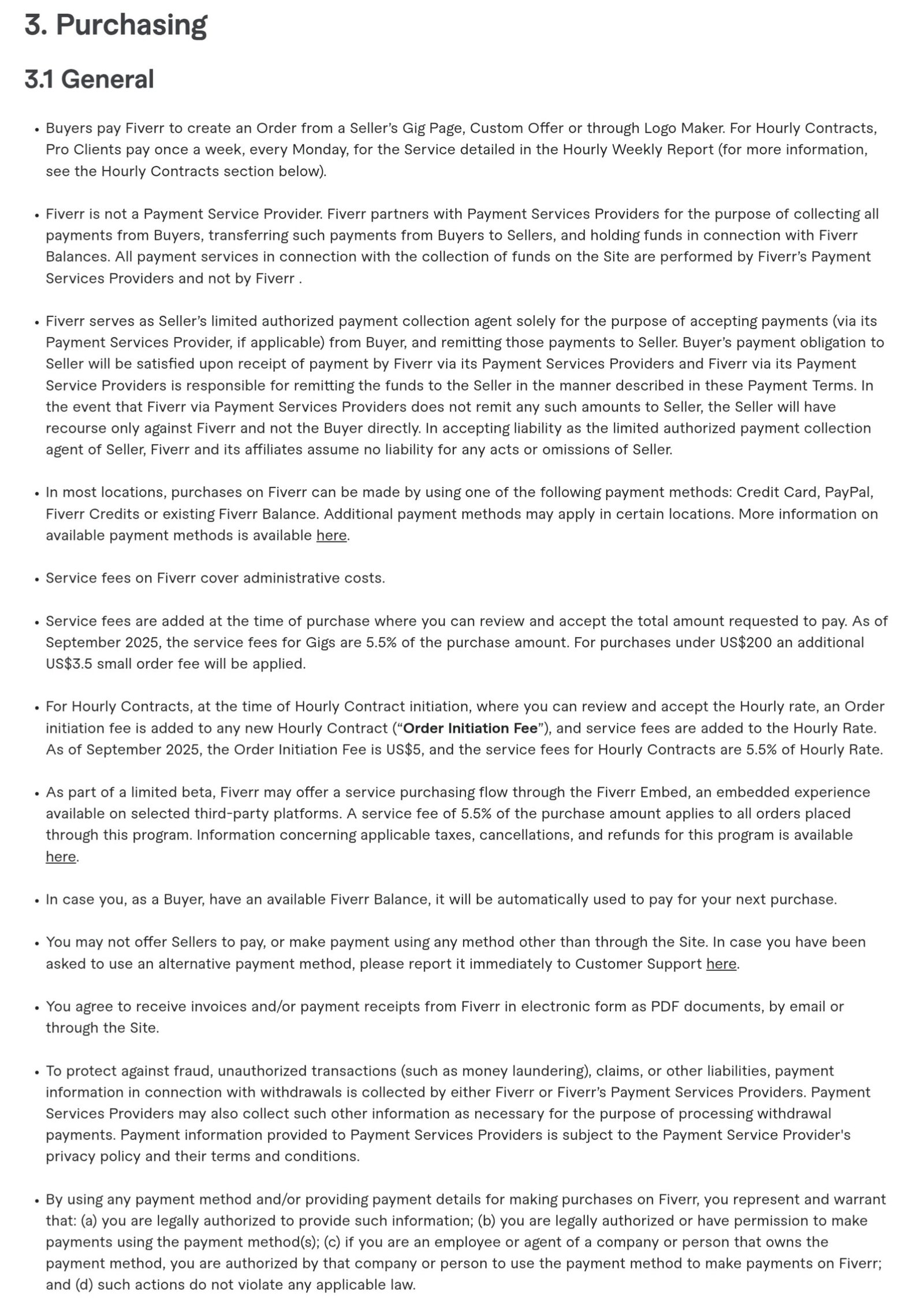
Fiverr takes a flat 20% from every seller payment — no discount for volume, no loyalty tier. On a $100 order you keep $80; on a $500 order you keep $400. Buyers separately pay a 5.5% service fee plus a $3.50 charge on orders under $200. That buyer-side fee doesn’t touch your earnings, but it does inflate checkout, which can affect conversion on lower-priced Gigs.

Upwork fees

Upwork charges a variable freelancer service fee of 0–15% per contract, shown to you before you submit a proposal and locked in once the contract starts. Most freelancers land around 10%. Clients pay a separate marketplace fee of roughly 3–10% depending on their plan. Beyond the service fee, Connects cost $0.15 each — no other hidden charges.

Real fee comparison on $500 earned

Fiverr seller fee (flat 20%)–$100
Upwork seller fee (~10% typical)–$50
Upwork Connects (active month, est.)–$15
Fiverr net$400
Upwork net$435

On $500 gross, Upwork puts roughly $35 more in your pocket even after Connects costs. Scale that to $5,000/month and the gap grows to around $350 a month in Upwork’s favor — over $4,000 a year.

Note on Upwork’s fee history: Upwork moved from a tiered model (20%/10%/5% based on lifetime billings per client) to a flat 10% in 2023, then updated again to the current variable 0–15% model on May 1, 2025. A lot of articles online still cite the old numbers — the rate you actually pay is shown per contract before you apply.

Which Platform Gets You Hired Faster?

For someone with zero reviews, Fiverr wins clearly. Publish a Gig and buyers can order the same day — no proposal, no Connects, no rejection email. The catch: Fiverr’s algorithm strongly favors sellers who already have reviews. A brand-new Gig sits below hundreds of competitors with thousands of completed orders, so most new sellers price aggressively at first just to land their first few reviews.

A content writer described pricing her blog-post Gig at $15 for 500 words just to get five reviews — once she had them and raised the price to $45, orders started coming in without her doing anything. The platform only starts working for you once you have proof you exist.

On Upwork, new freelancers sending 10–15 proposals a week typically land their first contract in 4 to 12 weeks. Niche matters — narrower specialties with less competition convert faster — and a complete profile with real portfolio samples shortens the timeline noticeably. That first review is the real turning point: before it, your profile reads as unproven no matter how strong your portfolio is.

Creative services

Design, writing, voiceover — start on Fiverr. One good Gig plus a few external shares can generate orders within days.

Technical services

Development, data, consulting — start on Upwork. Clients want to evaluate you first, and that suits proposals over a Gig shelf.

Client Quality

Fiverr buyers on the standard marketplace tend to be budget-conscious — a $30 logo, a quick article, a short voiceover. Per Fiverr’s FY2025 results, annual spend per buyer reached $342 as of December 2025, up from $302 the year before — a smaller but higher-spending buyer base as Fiverr pushes into higher-value work. Fiverr Pro changes this: it’s a vetted tier connecting premium sellers to business buyers who expect more and pay for it, though reaching Pro requires a formal application and a track record.

Upwork attracts a wider client range including real enterprise budgets — third-party analyses estimate many Upwork clients spend over $5,000 a year, with large accounts running into six figures. These clients write detailed briefs and want to evaluate you before hiring, which is a fundamentally different relationship than a Fiverr buyer placing an order.

Earning Potential

Upwork pays more on average. Third-party analyses put the average project around $800, with a meaningful share of contracts paying $1,000+. Fiverr’s average order runs $50–$500, and income there scales through volume and repeat buyers rather than high per-project rates — most Fiverr sellers earn somewhere between $5,000 and $30,000 a year, with Pro sellers as the outliers who report much more after years of building a reputation.

For specialized technical work, Upwork’s higher project values plus its lower fee produce better take-home pay. For high-volume creative Gig businesses with an established review base, Fiverr can be genuinely competitive — just through a different route.

Best Niches Per Platform

Fiverr works better for: logo and brand design, social graphics, video editing, voiceover, article writing, translation, quick website builds, 3D/interior renders.

Upwork works better for: full-stack and mobile development, AI/ML engineering, ongoing UX/UI product work, technical writing, marketing strategy, financial analysis, legal consulting, data science.

AI-related skills are gaining demand on both platforms, but the bigger, longer-running AI projects tend to concentrate on Upwork.

AI Tools on Each Platform

Upwork’s Uma is a built-in AI assistant that helps freelancers draft stronger, faster proposals directly in the application flow — useful for a first draft, though your own voice still matters for the final version.

Fiverr Neo is buyer-facing: it reads a project brief and recommends relevant Gigs, which can surface your listing to buyers who wouldn’t have found you through search. Fiverr Go is seller-facing — it builds a personalized AI assistant from your profile and Gigs that can respond to buyer messages between working hours, which matters because Fiverr’s algorithm penalizes slow response times.

Dispute Resolution

Fiverr disputes go through its Resolution Centre, and refunds don’t always involve a thorough review of whether delivered work actually matched the brief. A web designer described delivering a full five-page WordPress site exactly to spec, only for the buyer to claim they’d “changed their mind” — Fiverr refunded 50% without requesting the delivered files. For work under $200 that risk is manageable; for anything larger, it’s worth factoring in.

Upwork’s process is more structured. Hourly contracts release funds weekly based on tracked activity logs with a five-day client review window; fixed-price contracts hold funds in escrow until both sides confirm milestone completion, with a formal review process before any refund.

Rule of thumb: under $200 per project, Fiverr’s dispute risk is acceptable for most work. Above $500, Upwork’s escrow and review process is worth the extra effort of writing proposals.

Can You Use Both at the Same Time?

Yes, and a lot of experienced freelancers do exactly this — neither platform requires exclusivity. The common pattern: Fiverr for quick, predictable fixed-price orders, Upwork for proposal-based work with long-term, higher-rate clients. One graphic designer summed it up well: Fiverr covers her fixed monthly costs, while Upwork is where the real client relationships and bigger projects come from — and losing either one would hurt, which is exactly why she isn’t relying on just one.

If you’re just starting out, though, splitting focus across two platforms usually slows progress on both. Getting your first 10 reviews on one platform, then expanding, tends to work better than spreading thin from day one.

Pros and Cons

Fiverr

✓ Strengths
  • No proposals — buyers come to you
  • Fastest first order for most service types
  • Fixed pricing = predictable income per Gig
  • Neo AI increases Gig visibility; Fiverr Go automates buyer replies
  • 700+ categories, broad niche coverage
  • Pro tier gives access to premium buyers
✕ Weaknesses
  • Flat 20% fee — highest of the major platforms
  • Algorithm strongly favors existing reviews
  • Low average order values ($50–$500)
  • Disputes can favor buyers on high-ticket work
  • Weak support for ongoing hourly relationships
  • Entry-level market is crowded

Upwork

✓ Strengths
  • Lower fees — variable 0–15%, typically ~10%
  • Higher average project values (~$800 estimated)
  • Structured milestone escrow, better freelancer protection
  • Supports long-term hourly retainers
  • Access to enterprise-level clients
  • Uma AI speeds up proposal writing
✕ Weaknesses
  • Connects cost money before you earn anything
  • 4–12 week timeline to first job for newcomers
  • Very competitive in broad, popular categories
  • More effort per application (proposals, portfolios)
  • Identity verification required upfront
  • Higher client expectations on communication/process

Final Verdict — Which Platform Wins by Freelancer Type

Choose Fiverr if you’re starting out with no reviews, offering clearly packaged creative services, want orders to come to you without writing proposals, and are willing to grow through volume and Gig optimization.

Choose Upwork if you’re experienced with a portfolio already, offering technical or consulting services, want long-term client relationships, and prioritize the lower fee and higher per-project earnings.

If you’re a complete beginner, start on Fiverr — zero upfront cost and a faster feedback loop make it the easier first step. If you already have real skills and proof of work, Upwork will almost certainly pay you more over time. Fiverr wins on accessibility and speed; Upwork wins on earnings, fees, and client quality once you’re past the beginner stage. Running both eventually is where most serious freelancers land — not because you couldn’t choose, but because the two genuinely serve different parts of the business.

Quick Decision Table by Service Type

ServicePlatformWhy
Logo & graphic designFiverrGig format suits fast, fixed-price creative work
Full-stack developmentUpworkComplex scope needs discussion and milestones
Article writing / bloggingFiverrHigh Gig volume, fast orders, word-count packages
AI / ML engineeringUpworkGrowing demand, high project values
Video editingFiverrVisual Gig previews convert well
Marketing strategyUpworkNeeds scoping calls and long-term relationships
Voiceover recordingFiverrAudio previews drive discovery
Financial / consultingUpworkHigh trust required, client wants to evaluate first
TranslationEitherActive demand on both — test both
UX/UI product designUpworkOngoing collaboration suits hourly contracts

Frequently Asked Questions

Fiverr vs Upwork — which is better?

It depends on your experience and service type. Fiverr is better for beginners and creative, fixed-price work since buyers find you directly. Upwork is better for experienced, technical, or consulting freelancers who want lower fees and bigger projects — the tradeoff is a slower start.

Is Fiverr or Upwork better for beginners in 2026?

Fiverr is easier to start on — create a Gig, set your price, and wait for buyers, with no proposals or Connects cost. Most beginners get their first order faster on Fiverr, though Upwork pays more per project once you’re established.

Which platform takes lower fees — Fiverr or Upwork?

Upwork charges a variable 0–15% freelancer fee per contract, typically around 10%. Fiverr charges a flat 20% on all seller earnings. On comparable earnings, Upwork’s fee is usually about half of Fiverr’s.

Is Fiverr free to use?

Yes, signing up and creating Gigs on Fiverr is free for both buyers and sellers. Fiverr makes money by taking a flat 20% commission from seller earnings and a separate service fee from buyers at checkout.

Is Fiverr an American company?

No. Fiverr was founded in 2010 in Tel Aviv, Israel, and is listed on the NYSE (ticker: FVRR). It now operates globally with buyers and sellers in 160+ countries.

Can I use both Fiverr and Upwork at the same time?

Yes. Both platforms allow simultaneous active accounts. Many experienced freelancers use Fiverr for quick fixed-price orders and Upwork for long-term contracts, which spreads client risk across both.

How long does it take to get your first job on Upwork?

For new freelancers sending 10–15 proposals a week, the typical first contract takes 4 to 12 weeks. Niche matters — specialized categories with less competition convert faster.

What does Reddit say about Fiverr vs Upwork?

Freelancer threads on Reddit generally echo this review: Fiverr is praised for how fast you can start, while Upwork is favored for fee savings and higher-value clients once you’re past the early proposal grind. Complaints on both sides tend to center on algorithm visibility and payment timing.

Which platform is better for graphic designers?

Fiverr works better for most graphic designers — logo design, brand identity, and social graphics suit its fixed-price, fast-order model. Upwork is better for ongoing product or UI design work that needs regular collaboration on an hourly contract.

Which platform pays more?

Upwork pays more on average. Third-party analyses estimate the average Upwork project at around $800, with a meaningful share of contracts paying over $1,000. Fiverr’s average order runs $50–$500, with average buyer spend at $342/year as of Fiverr’s FY2025 results.

Is Fiverr Pro worth applying for?

Yes, if you qualify. Fiverr Pro is a vetted tier that puts you in front of higher-budget business buyers, though it requires a formal application and a demonstrated track record — a long-term goal rather than a starting point for most sellers.

Similar Posts