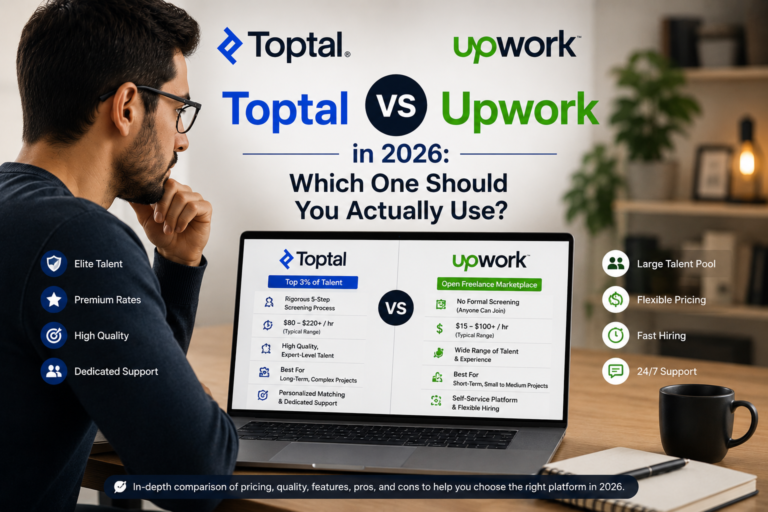

Freelance Platform Reviews · Updated 2026
Is Toptal Worth It? 2026 Review
Toptal says it only accepts the top 3% of applicants. Here’s what that screening actually involves, what it costs on both sides, and what freelancers really earn once they’re in — researched directly against Toptal’s own documentation and freelancer-reported figures, so you can decide whether it’s worth it before you sink weeks into an application.
Toptal earns its reputation if you’re an experienced developer, designer, finance pro, or project manager who can get through a multi-week vetting process. It’s a poor match if you’re just starting out, work in a creative field like writing or video, or need money coming in within a couple of weeks.
What Is Toptal?
Toptal — short for “Top Talent” — isn’t an open marketplace like Upwork or Fiverr where freelancers bid on job posts. It’s a curated network: Toptal screens applicants first, keeps only a thin slice of them, and then a dedicated “matcher” pairs those vetted freelancers directly with client projects.
Founded in 2010, Toptal has become one of the best-known names in premium remote hiring, with a client list that has included companies like Airbnb, HP, and Udemy alongside thousands of smaller startups. It sticks to four categories — software development, design, finance, and product/project management. If you’re a writer, video editor, or marketer, this isn’t your platform; that audience is better served by Fiverr or Upwork.
Not sure Toptal fits your skill set?
See how the two biggest open marketplaces compare in our Fiverr vs Upwork breakdown — a better starting point if you do creative, writing, or entry-level freelance work.
How Does Toptal Work?
Once you’re accepted into the network, the freelancer side looks like this:
- Build your profile — tag every skill accurately, since matchers use those tags to surface you for relevant jobs.
- Set your rate — you choose your own hourly rate, and Toptal negotiates the client-facing price separately.
- Get matched — a matcher sends job invitations that fit your profile; Toptal claims most clients are introduced to a candidate within 24 hours of a request.
- Respond fast — invitations generally expect a reply within 24 hours or you risk losing the opportunity.
- Work the engagement — Toptal handles contracts, invoicing, and billing so you’re not chasing clients for payment.
For clients, it works closer to a staffing agency than a job board: you describe the role, a Toptal expert manually shortlists candidates, and you interview and pick from that shortlist instead of sorting through hundreds of open proposals yourself.
Is Toptal Legit?
Yes. Toptal has been operating since 2010 and is regularly cited as the benchmark other “vetted freelancer” platforms measure themselves against. A few concrete signals worth knowing:
- Its screening methodology is documented publicly on its own site rather than just claimed.
- The company has acquired other businesses in managed delivery and marketing — a sign of real revenue, not a shell operation.
- Client billing runs on structured Net 10 invoicing and standard contracts rather than informal arrangements.
The real “is Toptal legit” question isn’t fraud — it’s whether the wait and the quality claims pay off. That’s the part worth digging into.
The Screening Process: How Hard Is It to Get In?
This is the single biggest factor in whether Toptal makes sense for you. Toptal’s own documentation puts the full screening at roughly 3–8 weeks depending on scheduling, though freelancers who move quickly between stages often finish in 2–5 weeks.
| Stage | What Happens |
|---|---|
| 1. Language & communication screen | A live call testing English fluency, professionalism, and personality fit. This alone filters out a large share of applicants. |
| 2. Skills test | A timed technical or domain assessment specific to your field — for developers, this is a coding test under time pressure. |
| 3. Live interview | A senior Toptal screener in your exact domain runs a live problem-solving or case-study session. |
| 4. Test project | An unpaid project, typically due within about two weeks, reviewed on code quality, structure, and communication. |
| 5. Final review | A shorter call confirming availability, working preferences, and readiness to take on client work. |
Toptal accepts fewer than 3% of the 200,000+ people who apply each year. The useful detail buried under that headline stat: most rejections happen in the first two stages, so if you make it to the live interview round, your odds improve noticeably.
How Much Does Toptal Cost?
The cost structure is completely different depending on which side of the table you’re sitting on.
For freelancers
Applying and joining the network is free, and Toptal doesn’t take a commission out of the rate you set — you keep it in full. Toptal’s margin comes from what it separately charges the client on top. The tradeoff for that “no visible fee” setup is that you can’t negotiate price directly with the client; Toptal’s team sits in between.
For clients
Client-side costs typically include:
- A refundable deposit of around $500 to start (applied to your first invoice, or refunded if you don’t hire anyone)
- An ongoing platform fee reported at roughly $79/month while you have an active engagement
- Hourly rates for talent generally ranging from about $60 to $200+/hour depending on seniority and specialty, with Toptal’s markup built into that number rather than disclosed separately
Clients also get a no-risk trial period — commonly cited as up to two weeks — to confirm a freelancer is a good fit before committing further.
How Much Do Toptal Freelancers Actually Make?
Because freelancers set their own rate, earnings vary by skill and specialty, but a few patterns show up consistently in freelancer reports:
- Senior developers and designers commonly report $80–$200+/hour once accepted.
- Since clients are pre-vetted and typically have real budgets, Toptal freelancers often spend less time “selling” themselves compared to open marketplaces — project values of $10,000–$15,000+ are common for larger engagements.
- The first payment tends to take longer than people expect — some freelancers cite four to six weeks while billing gets set up — even though ongoing invoicing follows Toptal’s standard twice-a-month cycle afterward.
If you want fast, small, frequent gigs, this earnings profile won’t feel like a fit. If you want fewer, larger, higher-paying engagements with less time spent pitching, it lines up well.
Pros and Cons of Toptal
- Pre-vetted clients with real budgets — far less race-to-the-bottom pricing than open marketplaces
- You set your own rate and keep it in full
- No bidding, proposal-writing, or endless cold pitching once you’re in
- Toptal handles contracts, invoicing, and payment collection
- Acceptance itself is a credibility signal to future clients
- Screening can take 2–8 weeks, entirely unpaid, with a roughly 3% acceptance rate
- Limited to tech, design, finance, and PM specialties — no writing, video, marketing, or general creative work
- You can’t negotiate price directly with the client
- First payment can take noticeably longer than on Upwork or Fiverr
- Not a fit for beginners — 2–3+ years of solid experience is effectively required to pass screening
Is Toptal Worth It for Freelancers?
Yes, if: you already have 2–3+ years of experience in software development, design, finance, or project management, you can absorb several weeks of unpaid application time, and you’d rather land fewer, bigger clients than grind through constant proposals.
No, if: you’re new to freelancing, work in a field Toptal doesn’t cover, or need income within the next few weeks — the screening timeline alone rules it out for urgent income needs.
Is Toptal Worth It for Clients Hiring Talent?
For companies, Toptal earns its cost when speed and quality matter more than price. Getting matched with pre-vetted candidates within about 24 hours, backed by a no-risk trial period, removes a lot of the hiring risk that comes with open marketplaces. It’s a weaker fit for small, low-budget tasks, since the $500 deposit and higher hourly rates only make sense for engagements substantial enough to justify them.
Toptal Alternatives
Toptal isn’t the only vetted-talent option, and it’s not the right fit for every specialty or budget:
- Upwork — open marketplace, far wider range of skills including creative and entry-level work, no waiting period to start applying
- Fiverr — best for smaller, fixed-price gigs and creative services rather than long, high-budget engagements
- Arc.dev — a lighter-weight vetted network focused specifically on developers
If you’re weighing the two most popular open platforms before considering a premium network like Toptal, our Fiverr vs Upwork breakdown covers fees, job types, and which one suits beginners better.
So, Is Toptal Worth It in 2026?
If you’re an experienced developer, designer, finance professional, or project manager who can afford a few unpaid weeks upfront, Toptal is one of the better-paying, lower-hassle places to build a freelance client base. If you’re new, work in a creative field, or need cash flow fast, the screening process makes it the wrong starting point — Upwork or Fiverr will get you working sooner.
Still deciding between open marketplaces? Check our Fiverr vs Upwork comparison for a side-by-side on fees and job types.
Frequently Asked Questions
Is Toptal worth it in 2026?
For experienced freelancers in tech, design, finance, or project management, yes — pre-vetted clients and higher average rates outweigh the multi-week screening process. For beginners or creative freelancers, it’s not the right platform.
What is Toptal?
Toptal is a curated freelance network that screens applicants before letting them in, then matches accepted freelancers directly with vetted clients in software development, design, finance, and project management.
Does Toptal charge freelancers a commission or fee?
No. Applying is free, and Toptal doesn’t take a cut of the rate you set as a freelancer. Its revenue comes from a separate markup charged to the client.
How hard is it to get into Toptal?
Very. Toptal accepts fewer than 3% of applicants across a five-stage process covering communication, a skills test, a live interview, and an unpaid test project. Most rejections happen in the first two stages.
How long does the Toptal screening process take?
Toptal’s own guidance is roughly 3–8 weeks depending on scheduling, though many applicants who move quickly between stages finish in 2–5 weeks.
How much does Toptal cost for clients?
Typically a refundable ~$500 deposit to start, a recurring platform fee reported around $79/month, and hourly talent rates roughly $60–$200+/hour depending on seniority and specialty.
How much do devs make on Toptal?
Senior developers commonly report $80–$200+/hour once accepted, often on larger engagements ($10,000–$15,000+) than typical open-marketplace gigs — though the first payment can take four to six weeks to arrive.
Is Toptal worth it according to Reddit?
Freelancer discussions on Reddit tend to echo this review: strong rates and better clients once accepted, but frustration with the length of the unpaid screening process and the delay before the first payment lands.
Is Toptal worth it for developers specifically?
Yes, more so than for most other categories — software development is Toptal’s largest and most established vertical, with the highest volume of client demand and typically the fastest matching once you’re accepted.
Is Toptal only for developers?
No, but it’s close — the network covers software development, design, finance, and product/project management. It doesn’t currently support writing, video, marketing, or most other creative freelance categories.
What’s a good Toptal alternative if I get rejected?
Upwork and Fiverr are the most common next steps since they have no acceptance barrier and cover far more job categories, including creative and entry-level work.