Online Course Platform Comparisons · 2026
Prices, refund rules and merger status last checked October 3, 2026.
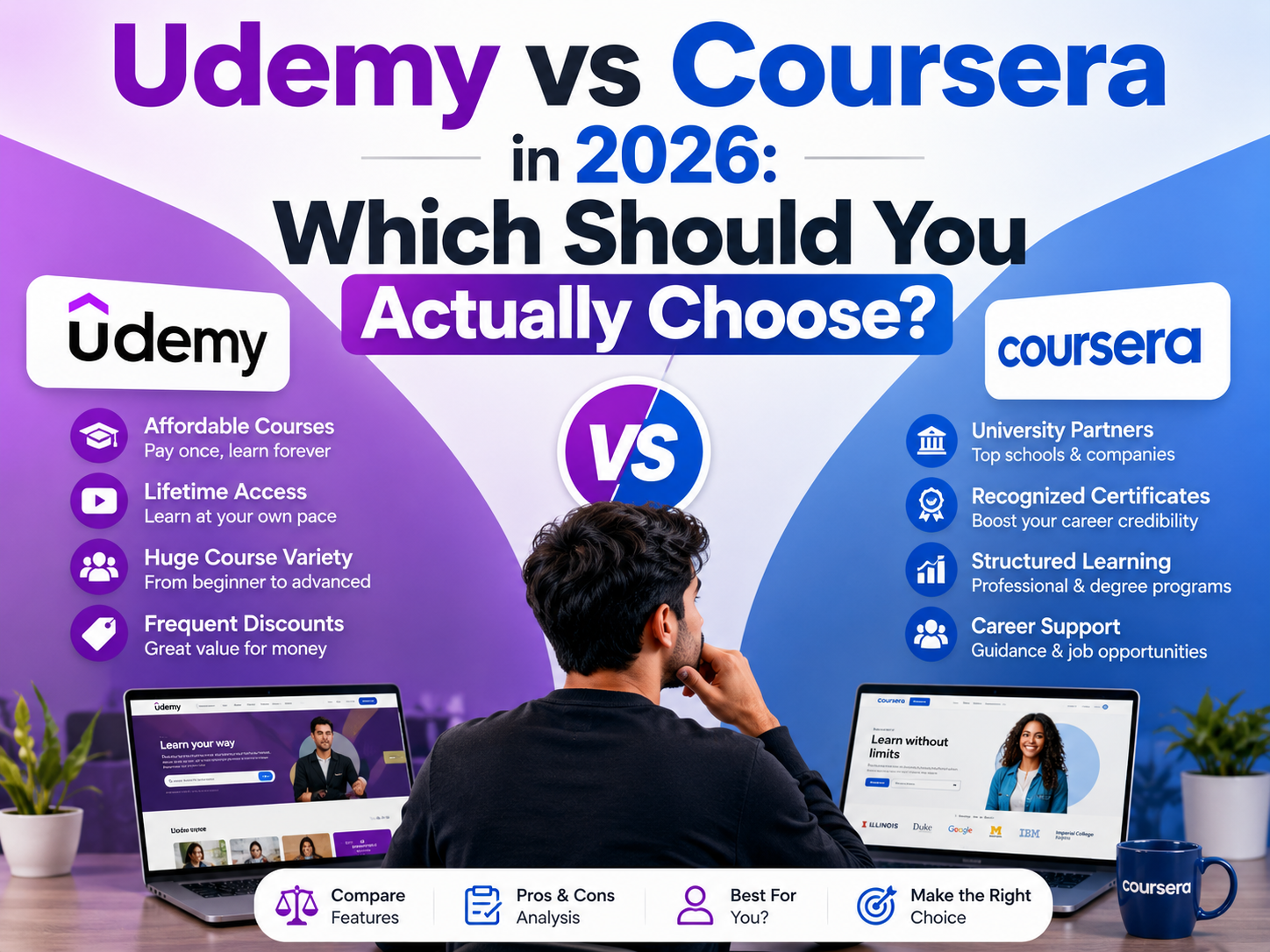
Udemy and Coursera both sell online courses, but they work in almost opposite ways. Udemy is an open marketplace where independent instructors sell individual courses (over 250,000 listed). Coursera partners with 350+ universities and companies and sells most of its 10,000+ courses through a subscription. This comparison covers pricing, refunds, catalog and certificates, using each platform’s own published figures.
Choose Udemy if you want one specific skill for a low one-time price, especially a technical or niche topic.
Choose Coursera if you want a university- or company-branded credential, or plan to work through several structured programs in a year.
Udemy vs Coursera at a Glance
| Factor | Udemy | Coursera |
|---|---|---|
| Model | Pay per course, or the Personal Plan subscription | Coursera Plus subscription, or pay per course or program |
| Typical cost | Courses often sell for about $10–$20 during sales; Personal Plan price varies by country and billing cycle | Coursera Plus: $59/month or $399/year (US list price); individual courses and programs: $49–$79/month |
| Library | 250,000+ courses | 10,000+ courses from 350+ universities and companies |
| Who teaches | Independent instructors; anyone can publish | Partner universities and companies such as Google, IBM, Stanford and Michigan |
| Certificate | Certificate of completion on paid courses; Udemy states it is not accredited | Certificate carrying the partner institution’s name; degrees and MasterTrack are separate products |
| Refunds | Eligible courses: 30 days. Subscriptions bought on Udemy.com: no 30-day guarantee | Plus monthly: 7-day free trial. Plus annual: 14-day money-back guarantee |
| Ownership | Both owned by Coursera, Inc. since May 11, 2026, still operating as separate sites | |
How They Work Differently
Udemy is a marketplace. Instructors create a course, set a list price and sell directly to students, and Udemy runs frequent promotions on top. Nobody vets each course for academic rigor, so the catalog is huge and fast to cover new topics, but quality depends on the individual instructor.
Coursera works through partnerships. Universities and companies publish courses on the platform, and most learners reach that catalog through Coursera Plus rather than buying courses one by one. The catalog is far smaller than Udemy’s, but every course has a named institution behind it.
Want a deeper look at each platform?
See our full Is Udemy Worth It review and our Is Coursera Worth It review. We also compared Udemy with another low-cost option in our Skillshare vs Udemy guide.
Pricing Compared
Udemy pricing
Instructors set list prices, but Udemy runs near-constant promotions, and many courses sell for roughly $10–$20 during a sale. There is no minimum spend, and a course you buy outright keeps lifetime access. Udemy also sells a Personal Plan subscription that opens a curated collection of courses (not the full 250,000+ catalog) for as long as you stay subscribed. Its price varies by country, billing cycle and promotion; US prices in 2026 have been reported anywhere from roughly $13 to $35 a month, so check the plan page before you subscribe.
Coursera pricing
Coursera Plus lists at $59/month (with a 7-day free trial) or $399/year (with a 14-day money-back guarantee) in the US. The annual plan works out to about $33 a month, and paying monthly overtakes the annual price after roughly seven months. Plus covers over 90% of Coursera’s courses, projects, Specializations and Professional Certificates, but certain programs are excluded, and degrees and MasterTrack Certificates are not included, so look for the Coursera Plus badge on a course page. Outside Plus, individual courses and programs run $49–$79 a month. Coursera discounts Plus from time to time (in spring 2026 the annual plan was offered at $239 for a limited period), so check the live price.
What it costs in practice
| Your goal | Udemy | Coursera |
|---|---|---|
| One specific skill course | About $10–$20 on sale, lifetime access | A month of Plus ($59) or one program at $49–$79/month |
| Ten short skill courses in a year | About $100–$200 at $10–$20 each | $399 for Plus annual, if the courses you want are in Plus |
| One Professional Certificate in about 3 months | No equivalent partner-issued program | About $147–$237 on a single-program plan ($49–$79 × 3), or about $177 on Plus monthly ($59 × 3) |
| Several programs across a year | Not the main use case | $399 Plus annual equals roughly 5–8 months of a single program at $79–$49 |
These are estimates built from list prices and typical sale prices; your region, promotions and pace will change the numbers.
Course Library
Udemy describes itself as a marketplace with over 250,000 courses and 80 million students. Programming, business, marketing, design, IT and personal development are all well covered, and niche or fast-moving topics tend to appear on Udemy first. The trade-off is that depth, accuracy and production quality differ from one instructor to the next.
Coursera’s catalog is smaller but institution-led: a Stanford machine learning course or a Google data analytics Professional Certificate rather than thousands of independent options. Coursera also offers full degrees priced separately by the awarding university, which sit outside Coursera Plus.
Certificates Compared
Udemy issues a certificate of completion for paid, approved courses. Free courses and practice-test-only courses don’t come with one. Udemy states that it is not an accredited institution and that its certificates demonstrate skills but cannot be used for formal accreditation.
Coursera certificates carry the name of the university or company that created the course, and Coursera Plus lets you earn an unlimited number of them. That co-branding is the main difference from Udemy. Neither platform’s certificate is an academic degree, and how much weight an employer gives either one depends on the role and industry, so a portfolio or project you built while learning often matters as much as the certificate itself. If you request a refund on Coursera Plus annual within the 14-day window, certificates earned during that period are revoked.
Judging Course Quality
Because anyone can publish on Udemy, check the number of ratings (not just the star score), the date the course was last updated, the curriculum outline and the free preview lectures before buying. For software and fast-changing tools, an old update date is a warning sign.
On Coursera, the partner’s name and the Coursera Plus badge are the first things to check, then whether the course includes graded assignments or hands-on projects. Courses tend to be more structured and more academic in tone than a tutorial from a working practitioner on Udemy.
Refunds and Free Trials
- Udemy courses: eligible courses bought on Udemy can be refunded within 30 days, subject to Udemy’s refund guidelines.
- Udemy subscriptions: plans bought through Udemy.com don’t carry the 30-day guarantee, and refunds aren’t available unless the law requires them. If you join through a free-trial promotion, you can cancel the trial without being charged.
- Coursera Plus monthly: a 7-day free trial; you aren’t charged until the trial ends.
- Coursera Plus annual: no free trial, but a 14-day window to request a refund from your purchases page.
Pros and Cons
Udemy
- Pay only for what you need, often $10–$20 on sale
- Very large catalog, including niche and fast-moving topics
- Lifetime access to courses you buy outright
- Certificates aren’t accredited and carry limited formal weight
- Quality varies widely by instructor
- Subscription purchases have no 30-day refund guarantee
Coursera
- Certificates carry the name of a university or company
- Plus covers over 90% of a 10,000+ course catalog for one price
- Structured Specializations and Professional Certificates
- $399/year (or $59/month) is steep for occasional learners
- Degrees, MasterTrack and some programs sit outside Plus
- Far fewer courses than Udemy for very niche topics
Which Should You Choose?
Pick Udemy if you need one or two specific skills, want to pay once, and are comfortable checking reviews and update dates yourself.
Pick Coursera if you want a credential with a university or company name on it, prefer a structured path, or plan to complete several programs over the year.
Use both if you want a structured, credentialed program from Coursera plus the occasional inexpensive Udemy course on a tool or topic Coursera doesn’t cover. The two still use separate accounts and billing.
What the Merger Means for You
On the day the deal closed, both companies said nothing changes for learners: your accounts, courses, subscriptions, pricing and earned certificates stay as they are, and the two sites stay separate. Coursera has since announced Project Helix, a unified platform built on both companies’ content, which it expects to reach enterprise customers in the first half of 2027. As of October 3, 2026, we haven’t seen a date announced for merging the two consumer sites, and we’ll update this page if that changes.
What About edX?
edX, founded by Harvard and MIT, is a third option built on the same university-partnership idea as Coursera. Its model lets you audit many courses for free and pay only if you want a verified certificate. It’s worth checking if the course you need comes from a university that isn’t on Coursera.
Frequently Asked Questions
Is Udemy or Coursera better?
Neither is better for everyone. Udemy is better for low-cost, specific skills bought one at a time. Coursera is better if you want university- or company-branded certificates and structured programs, especially if you will complete several in a year.
Does Coursera own Udemy now?
Yes. Coursera completed its all-stock acquisition of Udemy on May 11, 2026, and Udemy is now a wholly owned subsidiary. The two platforms still operate separately with their own accounts, catalogs and pricing.
Is Coursera more expensive than Udemy?
For most skill courses, yes. Udemy courses often sell for about $10–$20 during sales, while Coursera Plus lists at $59/month or $399/year and individual programs run $49–$79/month. Coursera’s cost is easier to justify when you want its partner-branded programs and plan to finish more than one or two.
Which has better certificates, Udemy or Coursera?
Coursera certificates carry the name of the partner university or company, while Udemy issues an unaccredited certificate of completion. Neither is an academic degree, and how much an employer values either depends on the role.
Can I use both Udemy and Coursera?
Yes. They are still separate platforms with separate accounts, so many learners use Coursera for structured, credentialed programs and Udemy for inexpensive courses on specific tools or topics.
Is Coursera Plus worth it compared to buying Udemy courses individually?
Only if you want Coursera’s university and company programs. Coursera Plus annual costs $399, which is roughly 5 to 8 months of a single program at $79 to $49 a month. If you just want skills at the lowest price, individual Udemy courses on sale usually cost less.
Can I get a refund on Udemy or Coursera?
Udemy refunds eligible courses within 30 days, but subscriptions bought on Udemy.com don’t carry that guarantee. Coursera Plus monthly has a 7-day free trial, and Coursera Plus annual has a 14-day money-back guarantee.
What’s the difference between Udemy, Coursera, and edX?
Udemy is an open marketplace where independent instructors publish courses. Coursera and edX both partner with universities and companies, and edX lets you audit many courses free and pay for a verified certificate.