Distance Learning Resources: A Practical Guide to Finding What Actually Works
“Distance learning resources” means something different depending on who’s asking — a parent looking for free practice tools, a college student who needs more than their school’s LMS, or an adult switching careers who’s staring at a dozen course platforms with no idea which one fits. This guide walks through the free and paid options that actually matter right now, explains when each one makes sense, and gives you a way to decide instead of just another long list of links.
In this guide
- What counts as a distance learning resource
- Who actually needs these resources
- Free distance learning resources worth knowing
- Paid online learning platforms — when they’re worth it
- Tools that make distance learning actually work
- How to choose the right resource
- Common mistakes to avoid
- Distance learning and the shift to remote work
- Frequently asked questions
What Counts as a “Distance Learning Resource”?
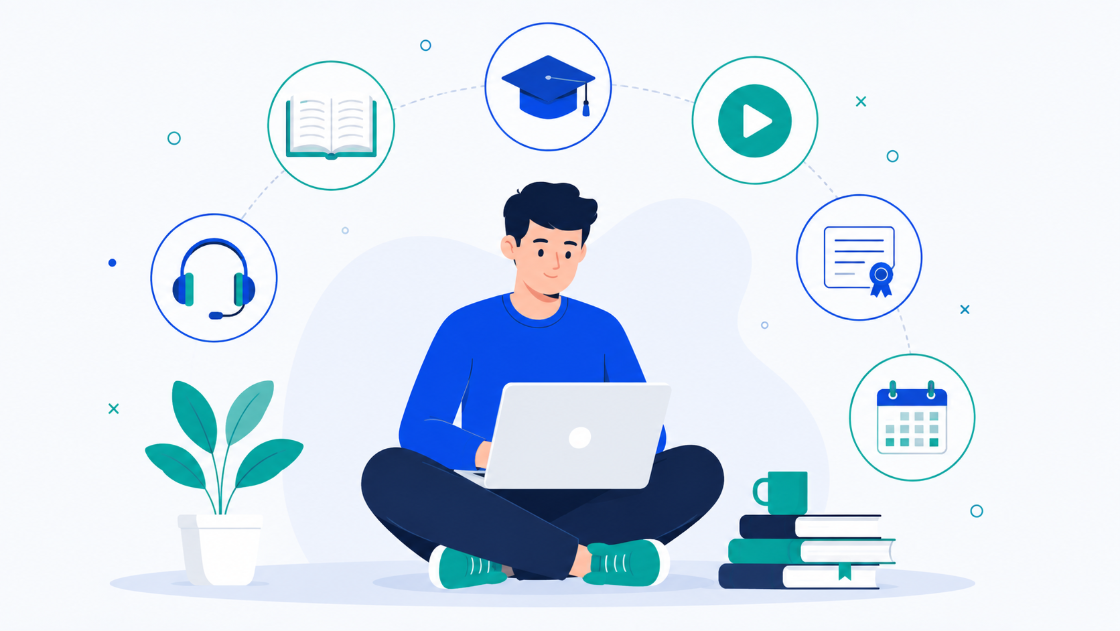
Distance learning resources is a broad label for anything that helps someone learn outside a physical classroom — full course platforms, learning management systems (LMS), open courseware, tutoring services, funding or device-access programs, and planning tools that teachers use to run instruction remotely. It overlaps with two terms people often use interchangeably: remote learning and online learning.
Remote learning specifically means instruction delivered while the teacher and student are in separate locations, usually because in-person attendance isn’t an option — a school closure, a rural district too spread out for a single classroom, or a scheduling conflict. Distance learning is the older, broader term. It includes remote learning plus formats that were never meant to be in-person at all, like self-paced correspondence-style courses or fully asynchronous online programs.
In practice, most people searching for “distance learning resources” want a mix of both: something they can start today (free or low-cost) and a sense of what to pay for once free options run out.
Who Actually Needs These Resources
What counts as a “good” resource changes a lot depending on who’s using it. Here’s how the goals typically break down.
K-12 Students and Parents
This group usually wants free or low-cost supplemental practice — filling gaps in math, reading, or science — or, for homeschooling families, a full curriculum plus tools to track progress against state standards.
College and University Students
Most colleges already provide an LMS like Canvas or Blackboard, so the real need here is supplemental: tutoring, practice problems, or study tools that go beyond what a professor posts. Distance learning resources fill the gaps between what’s assigned and what’s actually understood.
Adult Learners and Career Changers
This is the group with the most options and the least guidance. Free resources rarely go deep enough for a career pivot, and there are dozens of paid platforms competing for the same learner — each with a different format, price model, and level of real-world credibility. Most of this guide is written with this group in mind, since it’s the one most search results ignore.
Educators and Trainers
Teachers and corporate trainers need a different category of resource altogether: LMS software, assessment tools, and professional development on how to teach remotely well, not just what content to assign.
Free Distance Learning Resources Worth Knowing
Government and Nonprofit Research Hubs
If you want vetted, research-backed information rather than a product pitch, two organizations are worth knowing. The U.S. Department of Education’s Institute of Education Sciences maintains the What Works Clearinghouse, a government-run library of research on which educational approaches actually have evidence behind them. The United States Distance Learning Association is the field’s longest-running nonprofit — useful for industry research, webinars, and its newsletter, though it’s better for staying current on the field than for finding a specific course to take today.
Free, Open Course Libraries
Khan Academy is the resource most people mean when they picture “free distance learning.” It’s a genuine 501(c)(3) nonprofit — free because it’s funded by donations and grants rather than tuition, which is why it can stay free without ads or a paywall. It currently offers 840+ free courses spanning core K-12 subjects through early college math and science.
One thing worth being clear on: Khan Academy is not, by itself, an accredited school. It doesn’t issue diplomas or official transcripts. It’s an excellent supplemental tool — many homeschooling families use it alongside a separate accredited curriculum or umbrella school specifically because Khan Academy covers the instruction well but doesn’t handle the official record-keeping side of things.
For learners who’ve outgrown K-12-level content, MIT OpenCourseWare publishes materials — lecture notes, problem sets, and in many cases full video lectures — from more than 2,500 actual MIT courses, free and under a Creative Commons license. The tradeoff is that it’s course materials, not an interactive platform: there’s no grading, discussion forum, or certificate at the end, so it suits self-directed learners more than people who need structure or a credential.
Paid Online Learning Platforms — When They’re Worth It
Free resources cover a lot of ground, but they run out once you need a structured path, a recognized credential, or accountability to actually finish something. Here’s how the major categories of paid platforms break down, based on what we’ve tested and reviewed directly.
University-Style and Credentialed Programs
If the goal is a credential that carries real weight — a certificate tied to an actual university or company — our Coursera review breaks down when the cost is justified and when it isn’t.
Skill-Building and Creative Platforms
For hands-on, portfolio-style skills — design, video editing, writing, illustration — Skillshare and Udemy are the two platforms most learners end up comparing. Our Skillshare vs. Udemy comparison lays out the actual differences in pricing model and course quality, and our Udemy legitimacy review answers the trust questions people usually have before buying an individual course.
Tech and Career-Specific Platforms
If you’re starting from zero on code, our Codecademy review covers whether its structured, hands-on approach is worth the subscription. For math, logic, and STEM fundamentals taught through interactive problem-solving rather than lecture videos, see our Brilliant review.
Professional Development Platforms
For working professionals maintaining or building job-relevant skills, our LinkedIn Learning review looks at whether the subscription earns its keep compared to more specialized alternatives. For broader, creativity- and communication-focused learning, our MasterClass review covers who it’s actually built for.
| Cost Model | How It Works | Good Fit When |
|---|---|---|
| Free | No cost, supported by donations or grants | You need practice or review, not a credential |
| Per-course purchase | One-time price for a single course, often discounted | You want one specific skill, no ongoing commitment |
| Subscription | Monthly or annual fee for broad access | You’ll take multiple courses over time |
| Employer or school-provided | Access is free to you, paid by your organization | Always check this before paying out of pocket |
Tools That Make Distance Learning Actually Work
Course content is only half of what makes distance learning work. The other half is the infrastructure around it — the part most “resource list” pages skip entirely:
- Video conferencing and virtual classrooms — Zoom, Google Meet, and Microsoft Teams handle live instruction, while Google Classroom bundles assignments, grading, and communication into one place for K-12 and college courses.
- Note-taking and organization apps — tools like Notion or Google Keep matter more in self-paced courses than in a physical classroom, since there’s no built-in structure keeping you on track between sessions.
- Time-management tools — a shared calendar app like Google Calendar, used to block off course time the way a class period would, replaces the schedule a physical classroom provides automatically.
- Device and internet access — many school districts and public libraries offer device loan programs and can point families toward low-cost internet options. If cost or access is the barrier, your local library or school district is usually the fastest starting point, since available programs vary by state and change over time.
How to Choose the Right Distance Learning Resource
Instead of comparing every option feature-by-feature, start with your actual goal. It narrows the field fast.
| Your Goal | Best Resource Type |
|---|---|
| Catch up or get ahead in a school subject | Free supplemental practice sites (e.g., Khan Academy) |
| Homeschool a full grade level | Accredited curriculum, with free tools as supplements |
| Build a portfolio-ready creative or technical skill | Skill-based paid platforms |
| Earn a credential recognized by employers | University-partnered platforms |
| Learn to code starting from zero | Structured, hands-on tech-specific platforms |
| Maintain professional or corporate skills | Professional development platforms |
| Research the field itself rather than take a course | Government and nonprofit research hubs |
Once you’ve narrowed by goal, run the option through a short checklist before committing:
- Does this need to be self-paced, or do you actually do better with a live schedule and deadlines?
- Do you need an accredited or employer-recognized credential, or is the skill itself the goal?
- What’s your realistic weekly time budget — and does the format match it?
- Is this a one-time need (a single course) or ongoing (worth a subscription)?
- Does your school or employer already provide free access to this, or something equivalent?
Common Mistakes to Avoid
- Choosing by brand recognition alone. The most-advertised platform isn’t automatically the best fit for your specific goal.
- Assuming free means worse, or paid means better. Plenty of free resources (Khan Academy included) are genuinely excellent for what they’re built for; plenty of paid platforms are overkill for a simple need.
- Skipping the accreditation check. If you need a credential for a job or transcript, confirm that before you pay — not after finishing the course.
- Signing up for three platforms at once. Distance learning already removes the built-in structure of a classroom; spreading yourself across multiple subscriptions usually means finishing none of them.
- Not checking device and internet requirements up front. Some platforms assume steady broadband and a full-size screen — worth confirming before you commit time or money.
Distance Learning and the Shift to Remote Work
For adult learners especially, distance learning rarely ends with a certificate — it usually leads somewhere. Once you’ve built a skill, the next question is often where to use it, and that’s where distance learning and remote work overlap directly.
If the goal is a remote job rather than freelance work, resources built specifically for that search are more efficient than general job boards. Our FlexJobs review and our Remote.co review both cover platforms built around remote-specific listings.
If the plan is to freelance with a newly learned skill instead, our Fiverr vs. Upwork comparison covers the two platforms most new freelancers start with, and our Toptal review covers the higher-end, application-only route for more specialized or senior-level work.
Frequently Asked Questions
What is OLC (Online Learning Consortium)?
OLC stands for the Online Learning Consortium, a nonprofit membership organization for higher education leaders, instructional designers, and institutions focused on improving the quality of online and digital teaching. It’s not a course platform for individual learners — it’s more of a professional and institutional resource, offering research, conferences, and quality-review tools mainly used by schools and educators rather than students directly.
Is distance learning the same as online learning?
They overlap but aren’t identical. Online learning specifically refers to instruction delivered over the internet. Distance learning is the broader category — it includes online learning but also older formats like mailed correspondence courses, meaning any instruction where the learner and instructor aren’t in the same physical space.
Are free distance learning resources as good as paid ones?
For practice, review, and building foundational understanding, often yes — free resources like Khan Academy are built and maintained by serious education nonprofits, not thrown together. Where paid platforms pull ahead is structure, accountability, and — critically — recognized credentials. If you just need to learn something, free can be enough. If you need proof you learned it, you’ll likely need a paid or institutional option.
Can distance learning resources replace an accredited degree?
Generally no, on their own. Most distance learning resources — free or paid — are designed to build or supplement skills, not to replace the formal accreditation process behind a degree. Some university-partnered platforms do offer accredited certificates or even full degree programs, but that’s a specific, labeled category, not the default for most course platforms.
Where to Go From Here
The right distance learning resource depends less on which one is “best” overall and more on matching the format to what you’re actually trying to do. Start with a free resource if you’re filling a gap or just testing interest, and move to a paid platform once you know exactly what credential or skill you’re after — that order saves both money and time. If the end goal is a remote job or freelance income once you’ve built the skill, the resources above on job platforms and freelance marketplaces are the logical next step.
Sources referenced: U.S. Department of Education (Institute of Education Sciences), United States Distance Learning Association, Online Learning Consortium, Khan Academy, and MIT OpenCourseWare. Program availability (such as device-loan or internet-access programs) varies by school district, library, and state — check with your local provider for current options.
Why trust this guide
Written by Shivam, who researches, writes, and fact-checks every review on PromaxReviews personally.
- Every platform mentioned here is checked against its official pricing and policy pages before publishing.
- Facts and figures are verified using primary sources, including government pages, official nonprofit pages, and the platforms themselves.
- This page is reviewed and updated when a platform changes its pricing, features, or policies.